Category Archives: Uncategorized

IB-PYP: Enabling children to develop ‘self management’ skills via ‘Essential Agreements’ develops confident students.

My school is a candidate school for the International Baccalaureate (IB). As part of the IB- PYP (Primary Years Program) we make ‘Essential Agreements’ about all areas of school life pertaining to staff, parents and students. My students have been developing ‘Essential Agreements’ about what they believe is important to them. Given support, these 4 and 5 year olds know what makes them feel confident and happy.

The notion of rules isn’t part of our classroom. These very young children were able to talk, question and develop agreements about how we will support each other in our classroom/school yard to be the best we can be. I think you’ll agree that our ‘Essential Agreements’ are positive and reflect a culture that enables students to develop self management skills.

We will ‘have a go’ at everything or ‘give it a crack’.

We will say well done to people when they do something good or try really hard.

We will always listen to the person who is talking.

We are good friends to everyone. We are a team.

We agree to be at the classroom ready to learn.

Looking out for each other is important to us.

We will always look after our belongings and bodies and pack up our things.

We may add to our agreements during the school year if needed. The children have illustrated an agreement each which are displayed in the classroom and referred to when needed. This week I’ll take photos of children role-playing each agreement for display and reflection. This approach really works!

Cheers Nina

4 Comments

Filed under Uncategorized

Best Practice must be Shared! Here’s some great practice shared by a colleague!

I just got an email from a colleague who has been reading my blog. I receive emails more than comments now which is fantastic. My blog is enabling me to make connections with some obviously very dedicated and wonderful teachers. It’s becoming a sharing community. Sue sent me an email and I have taken a little part of it to share and I’m sure she won’t mind.

‘Have you discovered ‘The Gruffalo’ by Julia Donaldson?  I became very familiar with the books by this author while in England.  Others are “Gruffalo’s Child” and Room on the Broom. There are quite a few, but I chose “The Gruffalo” to begin the year.   My twin  grand daughters (only 2 years old) were eager to quote huge chunks of the story, while I read to them daily.   I began my Preps this year with the focus on being brave and confident enough to approach new situations. I introduced the story and they just loved it.  By chance, it was also a great way of introducing rhyme to them, especially in reference to the content in Prep English on Line assessments rhyming words… snake/lake. They are now all making the same connection from the story. My Preps are now asking for the story to be read to them over and over again. Even the parents have commented how interested some children have become in books and are talking about a great story they heard at school.  You know how initially Preps rarely tell their parents what they have done at school! An excellent new DVD of the story (30 mins only) will soon be released for sale in Australia featuring voices of many well-known actors.  I obtained a copy while in England and the revised story, music and animation is amazing.’

Thank you Sue – You know who you are. I don’t know this book but I’m going to find it because I love the teaching ideas that you are developing. It’s interesting to note that we’ve both been teaching for many years and still have that enthusiasm and desire to learn and improve our practice. I’ve been completing the ‘English on Line’ assessment as well and it has been interesting to see how challenging rhyme is for young children. I wrote a post some time ago and thought visitors to this post might like to read it – follow this link : Young children are born poets: Why poetry, rhyme and chant is essential for all children but crucial for the struggling reader!

 Once again thanks for your comments and emails and keep them coming. Let me know if you’re happy to have your ideas shared.

 Cheers Nina

2 Comments

Filed under Uncategorized

PrepD Student Led Interactive Writing – Differentiation – Preps (First year of formal education in Australia) – Language Experience: 5 days in and we’re composing! Student Led – Of course!

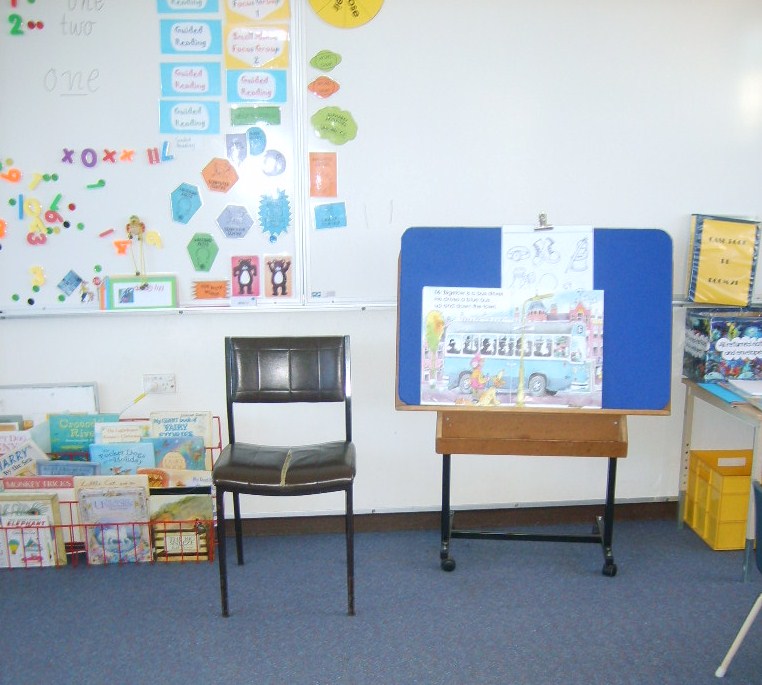
I said in my last post that I’d display a couple of photos of how I’ve set up our learning spaces in the classroom.  Space is tight, but it works.

This area is where we work on our reading and writing skills. Everything I need or the children need is in this space. They are learning quickly that where I sit, they sit in front of me. This allows the children to refocus for new learning experiences. It also gives them the opportunity to move and stretch. My space is limited, but I’ve been able to create these specific learning areas. I highly recommend teachers to try and organise different learnings spaces for the children. There is also a computer hub.   

This is our Big Book, oral language and numeracy area.  The white board is fantastic. The rest of the classroom has tables in groups. There aren’t many displays up as yet because we have only been back at school for a short time.

Our first Student Led Interactive Writing Session.

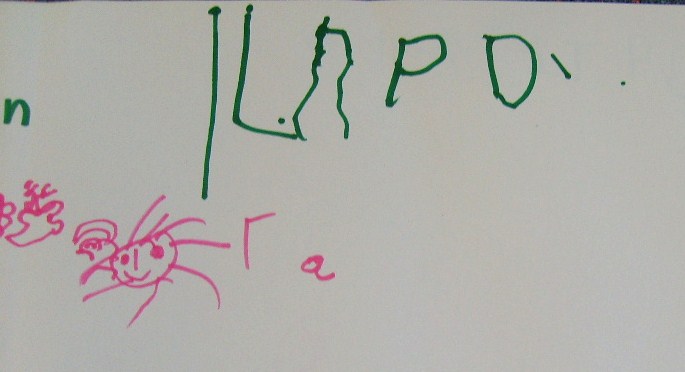
As a group the children have a collective knowledge of letters, we’ve looked at sentences, know they tell us something, have a capital letter, full stop and can be read.  They capably wrote their names in a colored texta down the side (removed from photo)  of their large poster sheet. We had talked about our experiences at school and as a group we came up with some class sentences for every group to ‘have a go’ at writing. Each child writes a word in the order of their names. Our sentences were, ‘I am at school’ and ‘I am in PD.’  I could hear them discussing the words, stretching them out, looking at the letter chart, working out how to write them and then ‘having a go’. 

The photo above shows the work of one group of students that I watched compose and write the two sentences. Their attempt at writing  ‘school’ is amazing. It will be wonderful watching their journey this year.

I’m using this strategy weekly, as I believe that this strategy combined with explicit teaching accelerates writing development. These children want to be writers!

I haven’t written many posts recently because I’ve been so busy setting up the grade, getting to know children and assessing.

Cheers Nina

2 Comments

Filed under Uncategorized

2010 The journey begins for a group of 4&5 Year Olds. Prep- The first formal year of education in the Australian school system begins. Follow our journey!

Yesterday was the very first day of formal education for 21 students in my Prep grade. They arrived with their parents, some grandparents and special others to celebrate the beginning of their 13 year journey (Prep to Year 12). After photos and goodbyes the parents and special others left leaving their most precious little people to start their journey.

Organisation and self management starts day one in our classroom. After settling the children, we talked about how we organise ourselves. Firstly, our belongings. The children produced their full schools bags and were shown where to put their lunch boxes, drink bottles, message bags, library bags and art smocks. They were then given a plain sticker to write their name on in bright colors. This sticker was placed where they will keep their bag. They will name all their books the same way. You will not walk into my classroom and find name tags pre made and placed. My children name all their belongings themselves and learn where they are to keep them. They had a name card to copy from if they were unsure. Most just wrote their name or something like it. It doesn’t matter because they know their sticker.

This morning the children arrived for their second day and promptly started unpacking their bag and placing everything where they were shown. Only one parent started to unpack their child’s bag and quickly stopped when I gently reminded her that her child knew where to put everything. These children are very capable of managing themselves when given the opportunity. The children will also be having an afternoon when they will invite their parents  into the classroom to show how we organise our classroom and how they organise themselves. I have also set up our classroom, which isn’t as big as my room last year with two distinct learning areas for the children to sit. They now know where ever I sit, they sit in front of me. This gives those restless young children an opportunity to move and refocus. This really does work and I’ll include some photos next week. Each area has a different focus and teaching aids ready to use.

Our day started with our reading of Big Books ( I have my favourites ) which involve movement and chant.  We looked at sentences, words and letters. As we are introducing THRASS as a strategy for teaching spelling, I introduced the chart. We started to get to know letter names and the sounds they make in certain words. Connections were being made, new words discovered and engagement was evident. These children are desperate to learn, they want to get going!

I asked a child want they really wanted to try and it was writing and reading. Perfect! We can do that… My teaching approach is Language Experience, so we talked about something we were all doing together and I got the answer I was looking for. They were all at school. I asked for a sentence. One child said, ‘I am at school.’ Once again this was the sentence I wanted. I then asked if anyone knew what an ‘ I ‘ looked like. Hands went up and a child came up to the board and wrote ‘I’. We were off and going strong. I showed them my hand signal for I and now they could read a word. The next word was ‘am’ , we stretched it out, listened to the sounds letters made in this word, looked at our chart, chanted it and had a think about what it might look like. They could tell me the initial sound ‘a’, so once again a child came up and wrote an ‘a’. As the children have had no handwriting lessons I urge them to ‘have a go’ and  write what they think represents the sound. It was interesting to note that the child looked at the THRASS chart. I introduced spaces between words, a capital letter and full stop. It doesn’t matter if they don’t remember, it’s the start and these ‘concepts of print’are explained over and over.

We continued until, as a grade we had written the sentence. Amazing! Their sentence was then put on a sentence strip, cut up and placed in our sentence strip board. This will be the first sentence in our first ‘Language Experience’ little book which will become a ‘take home’ book. We played games with the words which they loved. With technology at my finger tip, I was able to type their sentence for them to trace, copy and illustrate. They really needed some table time to complete a task and enjoy producing something for their ‘I am at school’ poster. Each child read the sentence to me. We’re reading and writing, problem solving and engaged.

‘ poster.

Cheers Nina

P.S Jacinta, if you read this post. I’ll be catching up soon and hope your first week of teaching has been wonderful.

2 Comments

Filed under Uncategorized

Why blog? One Year in…

It’s fair to say that there are differing opinions among my colleagues about why I and many others blog. I used to feel a little ‘miffed’ when colleagues questioned me, now I don’t. I write in order to reflect and reflect so I can write. I share my practice openly and have found that others share their practice with me.

My teaching and learning has changed because I have been able to make contact and share with educators globally. The pool of knowledge and experience I have been able to access has been enormous. My professional development, which is substantial, has not cost my school anything.

I started blogging on the 18th of January, 2009. Yesterday was my 1st anniversary. When I started, I wondered if anyone would be interested in what I do, would anyone ever leave a comment and was it worth the risk of putting myself and my teaching practice ‘out there’.

Now, when I read my first post, I think ‘wow’, I’ve really changed my practice. I have a deeper pedagogical understanding of how students learn and have accessed and read the research of many of education’s great thinkers.   

My First Year of Blogging Statistics:

I have written 124 posts.

There are 169 comments made.

I have had 17, 059 hits.

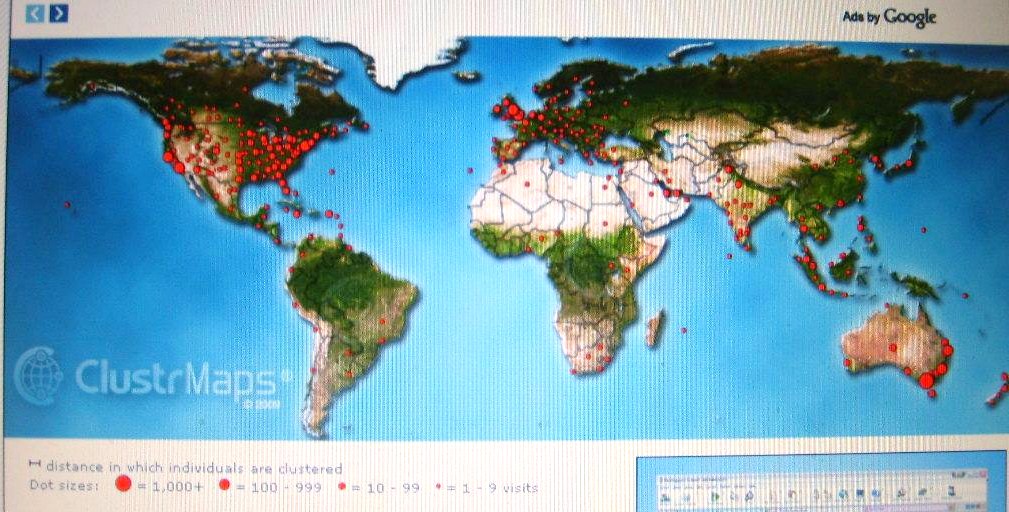
My 2009 Cluster Map (Archived)  

Thanks for visiting, commenting and sharing what you do with me.  Take the time to watch this video which was posted on Lucacept. I think all teachers should view this. We can get so ‘bogged down’ in the small things and forget the big picture.  Love his comment, ‘stay hungry, stay foolish’. 

Cheers Nina

Leave a comment

Filed under Uncategorized

Responding to a comment: What does a typical day or writing block of writing instruction look like? Great question Angela! I can only hope my answer is great. Hmm! Here ’tis’…

Angela Stockman is a coach in New York and has left a comment on my post about Student Led Interactive Writing. I’ve included a copy of Angela’s comment below because it has a number of questions. I also thought a comment box just wouldn’t give this comment justice. You can visit Angela’s site by following this link and I strongly recommend that you do.

I find explaining what I do difficult because ‘I know what I know and do what I do’ naturally. It’s that ‘unconsciously skilled’ verses ‘consciously skilled’ biting back again. Once again I need to reflect in order to write and write in order to reflect… and I would have to say that is one of the reasons I blog. It makes me define my practice, thus moving me from ‘unconsciously skilled’ to ‘consciously skilled’. In order to share what I do, I need to operate in the later.

Angela’s Comment:

‘It is so inspiring to hear an experienced primary teacher speak to the fact that students CAN and DO teach their peers, reflect on their learning, and define their own needs. What does a typical day or block of writing instruction look like for you structurally Nina? I am fascinated by this!

I facilitate a writing community of teachers and young people. We are hopeful that over time, many of the kids in our program will evolve into great teachers of writing, and we work to identify those kids and support them by providing them with great teaching strategies and opportunities now. I’m wondering if your approach might help us!’

Background:

Four years ago I was teaching a Year 3 / 4 (8 – 10 year old students in Australia) and at the time we were preparing for our government testing. I was talking to my students and they asked me what a good piece of writing was in my opinion. What a great question and one they were entitled to ask. We had been looking at writing genres in-depth but somewhere along the way my teaching missed the mark.

For my students to improve their writing skills they needed to know what a good piece of writing ‘looks like’ when written, ‘sounds like’, and ‘feels like’ when read.  To do this I used the deconstruction model introduced to me by Lane Clark. I proceeded to gather what I believed were good examples of writing for each genre. At the time I used material taken from CARS & STARS a reading comprehension program I was using. The children then worked in groups and used the ‘jigsaw’ thinking tool to record their findings. Sharing our findings as a class was powerful and meant we had to negotiate writing criteria for good pieces of writing. This was a great start, but just not enough.

I remember showing my students the Victorian Essential Learning Standards Moderation Guide. The document wasn’t suitable in its form due to its language, so I decided change parts of it for my students to use. This made the document ‘user friendly’ for the students. As a whole grade, we went through the document which included writing samples – this visual component was essential for the children. I noted at the time that the engagement level of my students skyrocketed because I think they felt that I was letting them in on ‘secret teacher’s business’.

Very bravely, they decided to look at their own writing and see where their writing measured up against the standards. To my surprise their personal and honest self assessment and conversations about their own writing was ‘bang on’. There are teachers who struggle with writing moderation, but these children did not. It also gave each student direction. I remember having a chat with each student, discussing their progress and given their new understanding, what they felt they needed to do to move their writing on.

Experience tells me that learning is positive for all children, no matter what their standard, if they can see their learning moving forward. It’s that ‘success builds success’ theory in action. Children feel empowered when they understand and have some control of their individual journey, making a commitment to self improvement/reflection and knowing what they need to do to improve. It’s no different for me; I like to know what is expected of me and how to move my teaching and learning forward.

I’ve always let children have a say about what our class should be like. We’re a team and all team members have a responsibility to each other and themselves. I have also allowed children to lead and question their learning, so it seemed natural for me to build on this… and the fact that I’m teaching 4-6 year olds didn’t alter my teaching philosophy. Hence, I try to make learning experiences student led when possible. I’ve been developing the PD Student Led Interactive Writing strategy for two years. This strategy is embedded in my teaching and I believe using this strategy enables children to develop a real understanding of the writing process. I also believe this strategy combined with the Early Years strategies will lead to long term gains, not short term. Please ‘track back’ through my blog as I have written many posts about this strategy.

So, what does a typical day or block of writing instruction look like structurally?

Writing everyday is crucial. I try to follow a program that becomes familiar to the children; however, nothing is set in concrete, so my program can be changed to respond to the children’s learning needs, our inquiry or their interest. Different genres  are introduced to support our planned inquiry. As many of my students are beginning writers, teaching genres tends to be left until later in the year. My program is Language Experience and Play Based Experience based. I won’t explain these in this post as explaining these approaches needs a dedicated post. However, if you put Language Experience in my search box you can read other posts I have written and view a  slide show for a presentation I gave.  If I gave this presentation again, my slide show would change. I am constantly learning, improving and refining my practice.

THE WEEKLY BASICS OF MY WRITING PROGRAM:

Oral Language– Build it daily:

I move children to different areas of the room for each activity. Movement is important for young children. I find it helps children to focus. I use these activities throughout the week to build oral language. Children with poor oral language find the going tough. Oral is crucial and underpins all that I do!

Oral Language Activities: Start every day – 10 Minutes – I  give my little strategies ‘made up’ names so that the children become familiar with the expected task.

The Chat Room:  Speaking and Listening – News, Show & Explain – Question & Statements

Give me Another Word & Then Another:  e.g. Go-start, begin etc… See how many words of similar meaning they can give for a word. Beginning of the year – Prep 1/2 – build to 10 words by the end of the year.

Talk About You Time: News

Big Pictures / Big Ideas:  Discussion

Daily Big Book Fun Time: Concepts of Print

Retell it!

What do we know about sentences, words, letters & punctuation?

Alphabet Knowledge – phonics / blends etc.

Disco Writing: Bee Gees – Staying Alive (Words changed to ‘Stay on the Line’ and ‘yes’ their is the dance. Sensory Activities, Letter Formation

Shared Experiences Recap: school life – incursions/excursions etc.

Build me a Sentence: Sentence Board, Magnetic Letters / Words, Mini White Boards  

Our Language Experience Little & Big Books made using Student Led Interactive Writing Text

Wonderings : Questions students would like answered is incorporated daily and used to direct focus content.

HERE ‘TIS’ – A ROUGH GUIDE!

Monday

10 Minute Writing Focus (teacher choice and/or a ‘Wondering’)

Modeled Writing Strategy (Whole Class) Revisit concepts, skills

Independent Journal Writing

Sharing and reflecting on our learning – 10 Minutes

Tuesday

10 Minute Writing Focus (teacher Choice and/or ‘A Wondering’ explained)

Using thinking tools and recording thoughts/discussion to assist our writing

Shared Writing Strategy – Responding to literature / Analyzing – understanding different types of writing

Sharing and  reflecting on our learning – 10 Minutes

Wonderings: Children brainstorm things they’d like to know and learn about related to writing.

Wednesday

10 Minute Writing Focus (teacher Choice and/or ‘A Wondering’ explained – related to genre)

Using thinking tools and recording thoughts/discussion to assist our writing

Independent Writing – Narratives, Letters, Reports, Recounts, Cartoons, Opinion etc…

 Sharing and reflecting on our learning – 10 Minutes

 Thursday

10 Minute Writing Focus (teacher Choice and/or ‘A Wondering’ explained – related to genre)

PD Student Led Interactive Writing – related to a shared experience (This is when I often take a ‘needs based’ group not ability group for Teacher Led Interactive Writing)

Sharing our reflecting on our learning – 10 Minutes

Wonderings: Children brainstorm things they’d like to know and learn about related to writing.

Friday

10 Minute Writing Focus (teacher Choice and/or ‘A Wondering’ explained – related to genre)

We Love to Write Workshop – free choice

Sharing our reflecting on our learning – 10 Minutes

I try to take a small group each day which is teacher led and rove and support children when not taking a group. Teacher Led Interactive Writing and Guided Writing are strategies I favor when working with small groups.

We also write at other times of the day to support our inquiry and for pleasure. The key for developing great writers is to build oral language. It’s hard to write if you don’t have a strong vocabulary to draw on. I call my teaching approach to literacy ‘The Interwoven Approach’. I weave all areas of language e.g. phonics, sentence structure, letter formation / recognition into my daily program and focus on a particular need.  I try to always link new knowledge to known concepts and understandings, so what is being taught is meaningful and in context.

There are numerous other things I do, but what I have described are the main strategies I consistently incorporate. As the year moves on, students are asked to lead / teach our writing focus and share time. Now if 4-6 year olds can confidently do this imagine what the capabilities of older students are.

To answer Angela’s second question- I believe that if a teacher just embedded Interactive Writing – PD Student Led & Teacher Led into their program, their children’s writing would FLY! Big statement, but I think I can ‘back it’.

Cheers Nina

P.S It’s hot in Melbourne – Its 1am and still in the 30’s. I tempted, no, going for a quick night swim – nice! 

To Angela: Once again thank you for your comment and I hope this makes sense. What do I need to make clearer?

5 Comments

Filed under Uncategorized

The Story of a 2009 Cluster Map! Time to move on…

I’ve recently received an email notifying me that my Cluster Map is going to be archived. Ah! I love my map because it shows where people who visit my blog live in the world. It lists the countries and although the map ‘hits’ data doesn’t actually match my statistics, I’ve enjoyed looking at my map develop.

I remember having the same conversation with Jenny Luca last year about her Cluster Map and not really understand her loss. Well, I understand now. Recently I told Jenny that it was happening to me and she said, ‘you get over it!’  That’s comforting… I can change the ‘url’ to keep my map, but as I can’t understand the instructions I’m going to let my map go and ‘suck it up’. Hmm!

So I can always remember my 2009 map, I’ve taken some photos of it to include in this post. This is my way of knowing that I can always visit and see my journey.

Cheers Nina

4 Comments

Filed under Uncategorized

Differentiated Teaching – Knowledge Scaffolding – The PrepD Student Led Interactive Writing Approach developed by Nina Davis – Would Dr John Munro support this strategy?

I have just finished reading an opinion piece, ‘Which children really benefit from streaming?’ written by Dr John Munro.  Reading this article has motivated me to write this post. Dr John Munro is an Associate Professor at the Melbourne Graduate School of Education, University of Melbourne – Australia. His article was published in ‘Shine’ – Department of Education and Early Childhood Development, Victoria, Australia – December 2009: Issue 11.

It’s reaffirming for me as a teacher to read articles based on sound research which support my practice. My teaching practice is one where children are encouraged to understand, monitor and share responsibility for their learning, and I do this with 4-6 year olds. Assessment ‘for learning’ and ‘as learning’ drives my teaching. My planning carefully embeds scaffolding strategies that build upon student knowledge. I believe this teaching approach differentiates teaching and learning in my classroom. Dr Munro’s findings support the PD Student Led Interactive Writing Approach that I have been developing for the past two years and have been recording and reflecting upon in this blog.

I have taken the following excerpts from Dr. Munro’s article that made me go ‘aha’…

‘When teachers use knowledge scaffolding procedures effectively, diversity can be catered for without the need to divide students into groups for learning.

‘Some teachers believe it is easier to teach a group that is homogeneous in its ‘ability’. They usually link ability with achievement; the ability grouping is based on past outcomes.

‘They miss the point that achievement is the result of learning (and teaching), not the means by which learning occurs.

‘When teachers use knowledge – scaffolding procedures effectively in their classroom, this diversity can be catered for without the need to divide students into groups or streams.’

‘Knowledge scaffolding is about establishing what students know at the beginning of the topic, and guiding them to enhance this by scaffolding and directing their learning and thinking activity.’

Dr Munro does concede that there will be times where like ability grouping will be needed, but our aim is to develop independent learners. I agree! 

Cheers Nina

Leave a comment

Filed under Uncategorized

How the internet can save time and money for parents…

Two reasons why the internet is GREAT for parents…

1. My recently turned 16-year-old son has shown me yet again why the internet is a great resource. His friends from school live in many different suburbs as most travel to school. He also has friends who are overseas visiting relatives for the holidays. I asked him recently why he was becoming nocturnal and his reply was that his friend from school was in England and he and group of mates have been meeting in an internet game to catch up. They regularly do this and chat while playing. Their game playing is very social. All have microphones / headphones and apart from the cost of the internet, their talking is free, no matter where their friends are in the world. No need for texting!

2. This christmas my son wanted two particular items for his computer. He had researched the parts, found the cheapest place to buy them and told me where I needed to go. Much to my surprise he also said that he had ordered the parts and they were being held. Well, address in hand  I headed off to a computer shop in a very industrial area of Clayton. I found the shop among the factories and walked in to find a very well-appointed office. After a short wait I sat down and said my son had ordered some items. Yes, I was a little skeptical! I said my son’s name, it was typed into the computer and then the salesperson went out the back and returned with the items packaged and the invoice ready.

Amazing! And ‘yes’ there needs to be balance, so as long as the internet is in balance with other life areas, as a parent I’m happy.

Cheers Nina

Leave a comment

Filed under Uncategorized

The PrepD Student Led Interactive Writing Approach developed by Nina Davis

I’ve had an email from a group of teachers wanting to know more about Interactive Writing. They’ve read about the strategy and have read my posts. Apparently, they have noted through extensive reading that my approach is unique. Yes, I have developed Interactive Writing into a Student Led Collaborative Approach that I use weekly as part of my Language Experience / Play Experience Approach to teaching literacy and numeracy.

Through ‘morphing’ this strategy, developing and embedding it into my classroom practice during the past two years, I have changed what is an excellent teacher led strategy, not used enough, into a powerful teaching strategy that I believe is the best strategy for teaching writing.

What makes my way powerful?

The key is that students are working collaboratively, sharing their learning, prompting each other and using skills and language generally used solely by teachers. Each student is engaged in the activity with each student committed to contributing with the support of their peers if needed. Groups can be structured to support children or to extend groups of children. The teacher can run a teacher led group at the same time, which I do regularly.

Each child is identified by a color and all are given the opportunity to lead a group. Teaching leadership skills concurrently is essential. The children are given poster sized sheets to write on and textas. I use Student Led Interactive Writing to assess and plan my weekly writing foci. It’s interesting to note that my student’s independent writing improves rapidly. I’m looking for the transfer of my teaching into my student’s Independent and Interactive Writing.  Modelled Writing and Shared Writing are also planned into a weekly program from week one.

By the middle of the year my students are able to identify their learning needs and will suggest the foci for writing sessions. That is powerful! Some children, and they are 5 or 6 years old, will teach the writing focus or make suggestions for me to use. Groups share their writing with the class, with little books made using their Interactive Writing texts used for reading. This strategy extends highly able students, develops students working at the standard expected and supports less able students. I believe it accelerates the writing ability of all students.

One teacher I work with had a child who refused to write for many weeks. Even though this is uncommon it is seen from time to time. The introduction of this strategy gave the child the support needed and confidence to start writing.

Please read my previous posts in this blog. I have written about this strategy many times and have provided numerous pictures and descriptions of my student’s writing development. I’d also recommend reading my posts on general Independent Writing development as I have provided many examples of student writing in these posts as well. I think once you’ve seen the development of my student’s writing you’ll be as excited as I am about this approach and keen to develop this approach in your own classroom.  I’m calling it the PD Student Led Interactive Writing Approach to recognise my student’s committment and success. They have a passion for writing and have taken exercise books home for the holidays to keep a journal. Many of my parents tell me that their children write at home because they love it. Now that is special! I can only hope that their enthusiasm continues as they grow.

Please let me know how you’re using this approach in your classroom.

Cheers Nina

7 Comments

Filed under Uncategorized