Tag Archives: young developing writers

Using my student’s writing to inform teaching and learning. Where do we go from here?

Angela Stockman ( a Literacy Coach in America) left a great comment on my last post asking me what I have taken away from the children’s writing which will inform program planning. I decided to write a post identifying the learning needs of my children. These needs will direct my planning.

Where do we go from here?

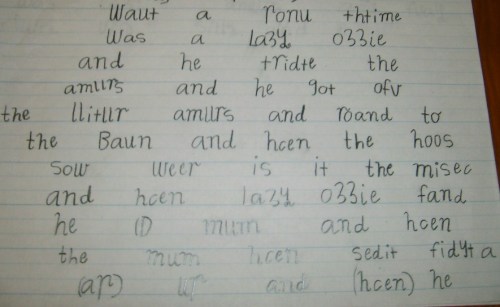
I have just reviewed my class writing samples based on the story Lazy Ozzie. There are a number of teaching needs that appear to be consistent across my grade. These teaching needs will direct my next fortnight’s whole class focus segments, where key learning needs are explicitly taught. Other learning needs will be taught to small groups of children needing extension or groups needing to revisit simple key skills and concepts. I also spend part of each writing session roving and working with individual students ‘at their point of need’. A number of my identified needs will be addressed during reading activities.

The Learning Needs:

Conventions of Spelling

  • Frequently occurring patterns of letters such as ‘ing’, ‘ow’, ‘ou’, ‘er’
  • Using more complex phonic conventions to spell words e.g. words that have the same sound pattern.
  • Looking at words with particular sounds e.g  farm, off, photo
  • Introduce common contractions- his, he’s, did not, didn’t  etc…
  • Review consonant diagraphs – ‘tr’, ‘ck’, ‘th’, ‘sh’
  • Ck Rule- Use a ‘ck’ when it follows a short sound of the vowels e.g. duck
  • Magic ‘e’ -When you have a word like mice the ‘e’ makes the word say its second sound e.g. cage
  • Ed & ing- If the last three letters of the base word are consonant-vowel-consonant double the last consonant before you add an ending that begins with a vowel e.g. swimming

 Writing Strategies

  • Continue to have students read back writing  ‘at the time of writing’ and at a later date
  • Checking writing for correct letter formation, spaces between words, use of full stops
  • Using commas, e.g. on the horse, on the cow – and lists
  • Reading writing to others  and reading back to self to make sure their writing makes sense
  • Checking spelling to make sure known sight words are correct
  • Continue using a simple plan – thinking about what I want to write, clearly defining a topic, adding detail to a topic, understanding concept of first draft, sequencing ideas to make sure they have a beginning, body and end using the ‘hamburger model’.

 Ideas Communicated in Writing

  • Expressing an opinion
  • Using high frequency words relevant to the topic – vocabulary building
  • Using a dictionary, creating personal dictionaries for our Inquiry topic
  • Identifying the main idea and subordinate ideas in texts.
  • Writing multiple sentences that relate to a chosen topic – Inquiry topic
 S5006606

I’ve asked Angela to look at my identified teaching and learning needs and add anything she thinks I have missed and there will be many. I’m always looking for feedback as I see myself as a learner and I often think I’m missing something obvious. I’d love to work with a coach.

Cheers Nina
4 Comments

Filed under Uncategorized

Lazy Ozzie – Extending writing: Building oral language is crucial to writing development!

S5006593

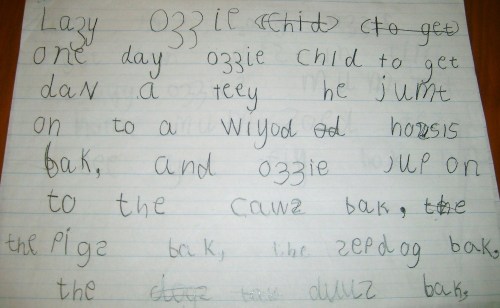
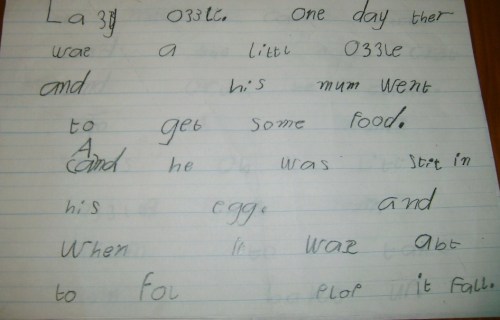
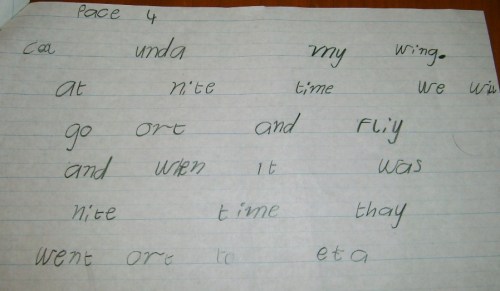
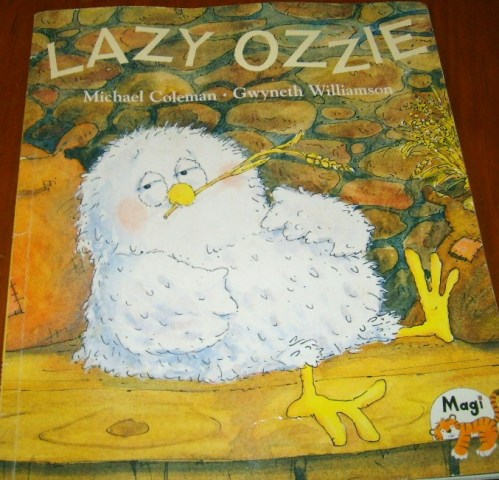
My Preps (5&6 year olds) have been using strategies to extend their writing. I read the wonderful story about Lazy Ozzie to them this week. It’s a repetitive text combined with a story. Just perfect for this task. The children were asked to retell the story read to them or write their own Lazy Ozzie story. I’ve been doing this activity since the beginning of the year and I’m thrilled with their efforts. I’m a huge supporter of Language Experience and believe that this approach/philosophy about how children learn has extended the ability of all children. I don’t believe it’s this cohort, as the writing of so many children in my grade is wonderful. Their reading and writing has developed from activities implemented daily which build oral language. Interactive writing, both student led and teacher led has also played a huge role and is one of the main strategies of the Language Experience approach.

Student 1.

S5006594

S5006595

S5006596

S5006597

Student 2.

S5006598

S5006599

Student 3.

S5006600

S5006601

S5006602

S5006603

Student 4.

S5006604

S5006605

I could keep on posting my children’s writing samples because they are wonderful.  If you have time read my previous posts from the beginning of the year and you’ll see how their writing has developed and the scaffolding strategies used a long the way. 

Cheers Nina 

P.S  I also am amazed that editing has become a natural part of the writing process for many of my students.

4 Comments

Filed under Uncategorized

Using an Editing Checklist! Our Journals… We are authors!

I’m spending alot of time talking about editing. Today I spoke to my preps about the writing process that authors go through. Authors write notes or a plan with lots of jottings or ideas. They then think about what they’re going to write and complete a first draft. This draft may stay a draft or it may become a piece of writing to be read by an audience. If it’s goinng to be read by an audience it has to be correct. I told them that authors correct their writing and then… they sometimes give it to a Wordsmith. Wordsmiths are people who correct the edited writing by an author. My preps understood this and it highlighted the process that writers go through.

S5006562

They are starting to understand that writing is a process. Today my children wrote a first draft about a topic of personal interest. When we were talking about Wordsmiths, one child put up their hand and said they wanted to be an engineer. This led to other children sharing what they wanted to be when they grew up. It’s a lovely converstaion to have with young children and some children decided to write about this.

S5006563

When they had finished their first draft I asked them to complete their writing checklist. See previous post – 5 Year Olds Can Develop Criteria for Editing. Hand Over the Responsibility. The class constructed  writing checklist will be completed by the children everytime they write. It is a powerful strategy which I believe inproves student writing.

S5006558

S5006568

S5006572

Cheers Nina

Leave a comment

Filed under Uncategorized

PrepD Interactive Writing – Here I go again! Assessment: Where are we now? Let them edit and watch them grow.

S5006532

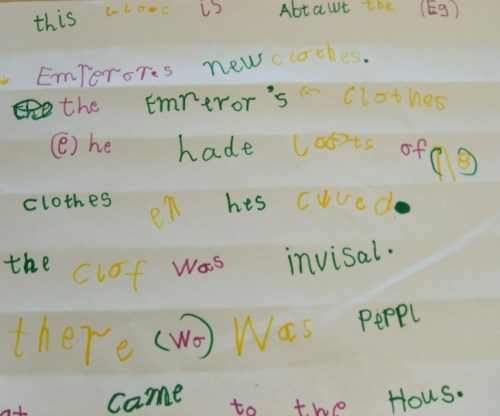
It’s now three quarters of the way through my Prep’s ( 5&6 Year Olds) first year of formal education in Australia. Today we investigated how we could remember what happened in a story. I asked them to think about what happened ‘simply’ first, before we put in the details. The hamburger model is an excellent visual and thinking tool for young children. The bottom bun is the beginning, the hamburger is the middle and the top bun is the end. The extra parts of the story become the lettuce, tomato, sauce etc… The children ‘get this’. After identifying the main parts of the story, we discussed the filling pieces of the story. These are the parts that ‘add color’, bring in background information about the characters,  the setting and mood. My preps will be learning more about these concepts in the coming weeks.

The children were asked to write 3 or 4 sentences about the story. I asked them to think about what the most important parts of the story were and write about those points. We looked at our writing checklist that we developed at the end of last term and decided to use it to edit when finished. It was interesting to note how seriously they took their editing. I could hear conversations among children when they were checking and identifying where they had forgotten to put a capital letter or a full stop etc. They decided not to tick a box until they had corrected their writing properly.

S5006533

S5006535

S5006539

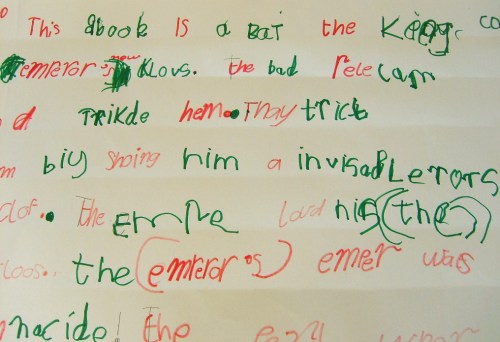
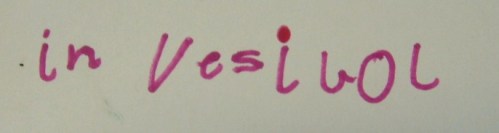
I’ve included pictures of their spellings of the word ‘invisible’. I’m really impressed by their ‘have a go’ attitude and their confidence to ‘take risks’ when writing. ‘Taking risks’ and ‘having a go’ are a huge factor in writing development. Children who feel they have to get the spelling of words write in their first draft will stick to safe simple words. Children who ‘take risks’ use exciting vocabulary and try to make their writing interesting. Developing the confidence in children to ‘take risks’ when writing starts day one. Praise and encouragement given when children first start writing is essential. The other children will be listening!

  S5006534

S5006543

S5006537

 The photo below is of a child recording ticks against the checklist. Young children are very capable. This group decided that they needed to add some more interesting words to their writing before they ticked the box.  I actually thought they did a great piece of writing, but as they were after sincere feedback, I encouraged the group to add two interesting words to their wrting.

S5006550                                                                                                                              

This is ‘thinking writing’ and by this I mean that it’s not a journal or recount. It’s much harder for the children to compose this sort of text because they have to think, discuss, respond and write. I hope you enjoy this post. Cheers Nina
Leave a comment

Filed under Uncategorized

Moving on up! Extending 5&6 Year Old’s Journal Writing: Children planning before writing!

Taking journal writing to the next level is the learning goal for this group of students. The focus has been extending the student’s journal writing by introducing scaffolding /planning  structures which help the children sequence their ideas.

The children usually write their personal journal on a Monday after a weekend, so it was a natural progression for the first scaffolding strategy to involve the days of the weekend. This starts with the children writing about Saturday and Sunday with the inclusion of a ’rounding off’ sentence or finishing sentence. Included in teaching sessions has been an introduction to adjectives or ‘coloring in words’ to ‘brighten up’ their writing by making  their writing more interesting. Adjectives are ‘creeping’ into to the student’s writing as transference from teaching sessions is embedded.

This week the students were introduced to another scaffolding plan based upon questioning. This simple plan involved the children writing one or two words for when?, who?, what?, where?, how? and why? A picture representing each question has been put in the plan to remind children what they have been asked to do.

105_0334

Jacinta (4th year teaching student intern)  introduced the plan using a big dice with when?, who? etc… on the sides. She rolled the dice and then modelled her own journal for the children. It is really important that the children know that the plan must only have one or two words per question. This was the first time the children have used a formal plan and it has helped the children who find extending their writing challenging. It has provided a scaffold for their ideas.

blog

The children will keep using this plan as it has helped them to organise their thoughts. A number of children wrote 2 pages of organised text and most wrote at least a page. I’ve got to keep reminding myself that these children are 5 or 6 years old and in their first year of formal schooling in Australia.

Cheers Nina

Leave a comment

Filed under Uncategorized

Language Experience Powerpoint- The Why? What? and How? of Language Experience!

NB: I’ve corrected the spelling mistake on slide 9!  Any others?  

This is my slideshow for a presentation I am giving focusing on Language Experience. A few slides have lost their clarity and I have had to substitute a number of photos for privacy reasons. After I’ve completed my presentation I’ll explain some of these slides via this blog. I’ve broken my presentation in to 3 distinct areas. The ‘why?’ is first, followed by the ‘what?’ and then most importantly I’ll be expalining my practice in the’how?’. As teachers, we get a lot of the ‘why?’ and ‘what?’, however, it’s the ‘how?’ which is often not explained and crucial to embedding new practice. Hopefully my presentation will address all three. The ‘how?’ has meant I’ve had to define my practice which is quite challenging. Anyway, take a look and let me know what you think.

Cheers Nina
Leave a comment

Filed under Uncategorized

The best group writing strategy for 5 year olds! PrepD Interactive Writing: Here I go again…and again…and again!

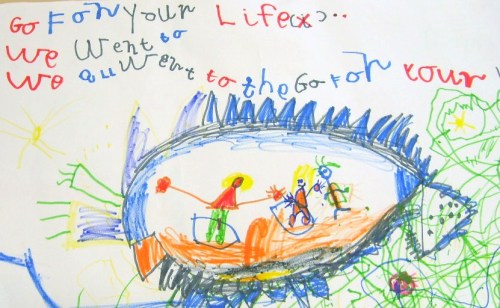
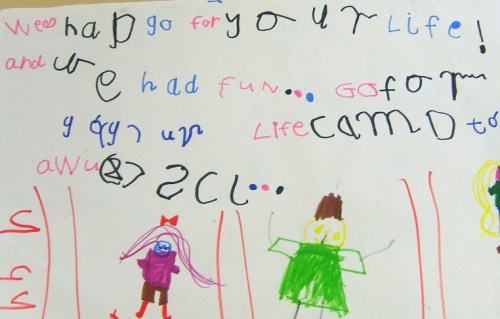
It’s the beginning of 2nd semester and my preps are half way through their first year of formal schooling in Australia. I’ve written many posts about Interactive Writing. The Early Years Program outlines Interactive Writing as a teacher directed writing strategy. However, I have developed this strategy into a student led whole grade activity.

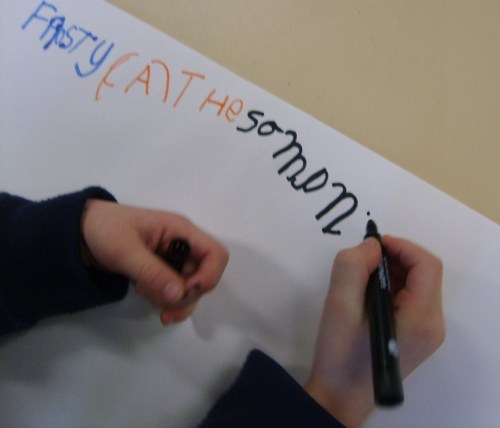
To make this writing strategy really special, I allow the children to write using textas on large sheets of paper. Children select a colour to write with and use this colour to write their name down the side and their contributions. While the children are writing I’m listening to their conversations and observing the strategies they have learnt in action. Leaders are selected to help organise this activity with all children being given an opportunity to lead at some stage.

It’s my belief that this strategy accelerates writing development and supports less confident writers. Teaching children to prompt, support but ‘not do for others’ allows children to help others in a productive way which flows through to other learning situations. Self editing becomes a natural extension of the process as children read back and fix up known errors. Groups share their writing and discuss ways they could improve their writing next time. This reinforces taught concepts.

At the beginning of the year the students brainstormed a sentence about a shared experience that all groups wrote. Now each group negotiates their own two sentences to write and share with others when completed. I’m looking at how children transfer what they have learnt into their writing e.g. simple punctuation (full stops, capital letters and exclamation marks), space between words, sentence structure and handwriting, specifically letter formation.

Photos – Interactive Writing July.

S5006253

S5006246

S5006256

To add to this activity, I sometimes immediately type and print their writing using ‘dotted tracing script’ which the children trace over.

S5006264

If interested, please read my previous posts about Interactive Writing. You can use the search bar in this blog to find previous entries.

Cheers Nina

Leave a comment

Filed under Uncategorized

Journal Writing: Our journey so far…

I always get excited when I see my students writing eagily and with confidence.  Today, they typed their journals into a word document and I have included their typed journals in the photos below. We reflected on what we know about writing and will soon be developing criteria for a checklist which be used when writing. I did this last year and it was very successful. I’ll include ‘how’ and ‘what’ in a future post.

S5006076

S5006077

S5006078

S5006079

Once again a random selection from my class. We’ve nearly completed two terms ( approx -19 weeks of formal schooling ) and all my students are moving forward. Each journey is different, but I know each student is proud of their achievements. How do I know? ….from their personal reflections!

Cheers Nina
Leave a comment

Filed under Uncategorized

Interactive Writing- 5 & 6 year olds are teachers, learners & leaders!

S5006056

‘Interactive writing involves the teacher and small groups of students jointly composing a large print text on a subject of interest to the students and sharing responsibility for the recording at various points in the writing. Teachers quickly record the words that students know how to write, and engage students in problem solving and recording the words that provide challenges and opportunities for new learning. This eases the transition to independent writing by: · making explicit how written language works · constructing words using orthographic and phonological knowledge · producing a text that can be read again.’ Sofweb

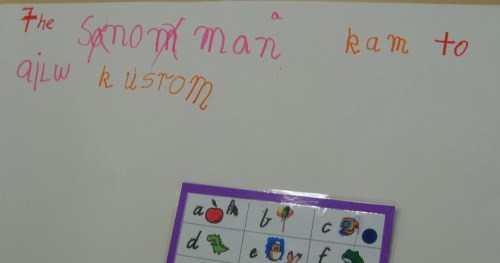
Language Experience: This week we had a snowman visit our grade, we observed, measured, wondered and recorded our snowman’s visit. Our shared experience became the topic for our Interactive Writing session for this week.  Group leaders were selected and total control was handed over to the children. They had to negotiate and form their own sentence/s for the first time. I am thrilled by their development as writers. My role was to observe, listen and stay in the backgound. The childen were the teachers, learners and leaders.

S5006037

S5006040

S5006049

S5006051

S5006055

Cheers Nina

Leave a comment

Filed under Uncategorized

The Writing Rich Classroom: I’m in my first year of school and I can write. Do you want to read it?

It’s the beginning of second term and I’m excited or should I say relieved! I’m whitnessing all my Prep’s writing confidence and ability leap forward. My ‘talk and write daily’ philosophy is working, combined with good Early Years practice i.e. Guided Writing, Interactive Writing, Modelled Writing, Shared Writing and Independent Writing.

I keep re-posting Interactive Writing because I truly believe it is a key strategy for early writers.

It’s wonderful to see Prep students (first year of formal education in Australia) work cooperatively in groups to produce a piece of writing within the first few weeks of school. They may not know all their sounds, but with an alphabet chart/pictures for reference and whatever prior knowledge they bring, writing skills are quickly developed and extended. This is a powerful teaching strategy.

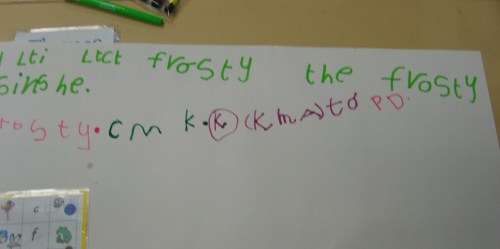
Each child has their own colored texta and writes their name down the side of the sheet making it easy to see a child’s progress. Generally, I have groups of 4/5 students selected randomly. At the beginning of the year the sentence is provided after class discussion and is related to a shared experience e.g. I am at school. Teaching children to prompt each other without giving the answer is taught during Interactive Writing. Read my earlier posts!

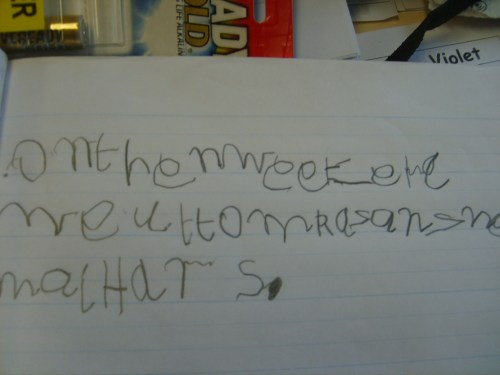
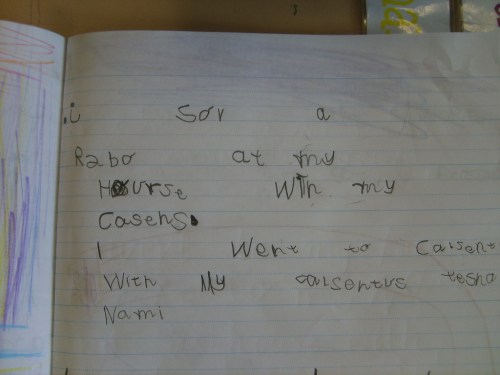
Below are some snapshots of my student’s writing taken randomly. The development and range in the grade can be seen, but they’re all on their way forward. This week we started what I call ‘real thinker’s writing’. This was a response to a text ‘ Water Bugs and Dragonflies’. I wanted to know if my preps (5 & 6 year olds)  could record their ideas. Journal / Recount writing becomes very comfortable for young children and can ‘stop’ them ‘moving on’ , if other writing opportunities aren’t given. Children can fall into the cycle of writing ‘ I went to the ….’ over and over. I was amazed by what my student’s wrote and will include photos in a future post. Here are some examples of their journal writing.

S5005756

S5005755

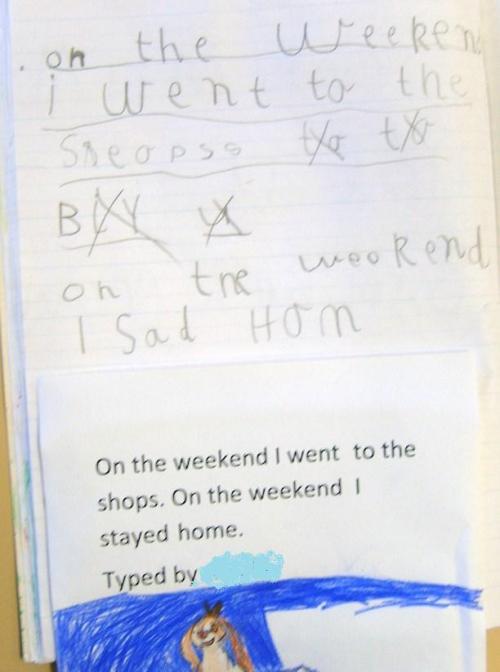
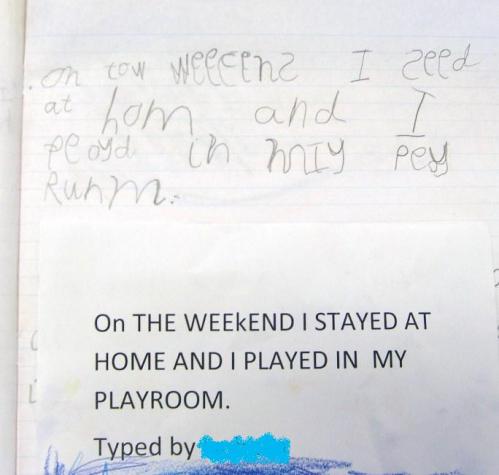
Sample 1: I stayed home. Sample 2: On the weekend I went to my cousin’s house. Sample 3: On the weekend I went to get some tyres.

S5005763

S5005766

One of my students brought their writing to me and challenged me to tell them what it said. I read it and they looked at me in wonder. The connection between writing and reading was made for this 5 year old. This student said, ‘you read it’ ( still with an amazed face). My response was, you asked me to!

Cheers Nina

2 Comments

Filed under Uncategorized