My PM Benchmark RAR Software Review…

PM and Mum's birthday 030 (2)

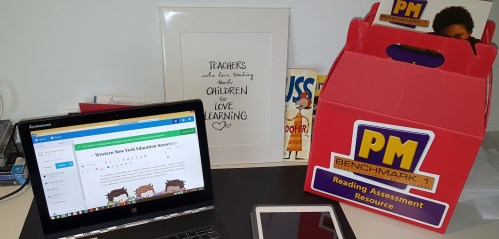
Today I viewed the PM Benchmark online assessment and its brilliant. Anyone who reads my blog knows that I’m always on the hunt for something that will make a teacher’s life easier and for me that means anything that will replace photocopying reams of sheets and endless filing.

I also believe there will be less teacher error when a student is reading at pace. I’m sure we’ve all had to ask a student to stop while we annotate. It happens! This program is very easy to use.  Error rates are calculated straight away and assessing errors is quick. The reporting features would enable class and cohort data to be quickly attained.

The PM Benchmark RAR Software is an annual, site licence subscription (365 days from date of purchase). Subscriptions are $200 for unlimited teacher access for an unlimited number of students.

Features include automation of assessment:

  • retelling
  • reading record
  • comprehension
  • miscue analysis
  • reading behaviors

The summary succinctly presents all facets of the assessment along with recommendations and a copy of the reading record.

Reporting features include:

  • individual progress graphs
  • customisable group reports and graphs
  • ability to export to Excel

Nelson Cengage Learning Website

Cheers Nina

1 Comment

Filed under Uncategorized

Western New York Education Associates: My Fellowship Project: Improved student writing leads to improved reading. (Part 1)

I’m probably undertaking the longest fellowship research project known to Angela Stockman. Deciding what to research when I have so many ideas has been the hardest thing. Nailing down something that I felt could make a difference and reaffirm something I have believed for some time has been the key to my moving forward.

cutecolorssetschool4b

Is there a positive impact on reading standards when students understand there are different writing genres and each genre has its own structure?

My answer is yes, but it’s not as simple as just saying that!

What I know!  When young children come to school many start writing and can read back their writing at the time of writing. However, many of these very young learners struggle to read back what they have written when presented with their writing at a later time.

What I know!  When is the shift ? Once students have learnt basic reading strategies and can read simple books (PM Level 5 or Fountas & Pinnell Level D) we have  shift. When combined with a core sight word list comprising of 30 words learners start moving rapidly.  Further vocabulary is learnt during the reading and writing process (context). These young learners are now learning about writing genres and how a text is written. They are connecting writing to reading and reading to writing…. and when they start seeing themselves as authors and sharing their writing with others they have purpose which means shift.

What I know! Focussing on teaching genres has an impact on a student’s understanding of how authors follow a set genre plan when writing. Once young learners are writing they are  initially  introduced to a Recount structure with the Narrative genre following soon after.

When young learners understand  genre structure  and start using  structures when composing their reading comprehension soars.

Example: Students who know there is a problem and solution in a narrative will look for the problem and solution when reading a text. Students who are learning the 6 Traits of Writing (Ideas and Content, Organization, Sentence Fluency, Voice an Word Choice) will be making connections to these when reading.

When young learners make the following connections – reading to writing and writing to reading their comprehension improves rapidly.

Young learners need to connect writing to reading and reading to writing and understand how each is reliant on the other. Reading skills need to be explicitly taught but not taught in isolation. Reading and writing sessions need to link prior learning to new learning including reading and writing small group teaching and assessment strategies.

Recently Angela Stockman sent me a link to The Writing Revolution.  This article was reaffirmed the learning trends I have been recording.

For years, nothing seemed capable of turning around New Dorp High School’s dismal performance—not firing bad teachers, not flashy education technology, not after-school programs. So, faced with closure, the school’s principal went all-in on a very specific curriculum reform, placing an overwhelming focus on teaching the basics of analytic writing, every day, in virtually every class. What followed was an extraordinary blossoming of student potential, across nearly every subject—one that has made New Dorp a model for educational reform. (The Writing Revolution)

Next post: Show me the data!

Cheers Nina

1 Comment

Filed under Uncategorized

The IB-PYP: Futures Planning & Learning

https://www.youtube.com/watch?v=wKYhWmZYXDc

World Economic Forum The World Economic Forum 2014 -Skills needed in the 21st Century The World Economic Forum 2014 Skills needed in the 21st Century Video 1: What will learning look like in 2028?

video 2: How do we plan for 10, 20 or 30 years time?

These videos are worth viewing. As a trained IB teacher having extensive experience working in an IB-PYP school, I believe the IB program provides the education our students need now and will need in the future.

Video 1: Why 2028? Students at my previous school are already partaking in many of these initiatives now!

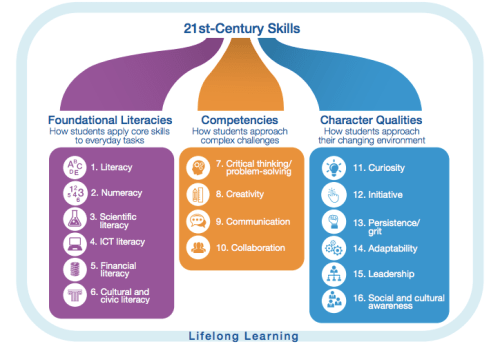
The World Economic Forum 2014 -Skills needed in the 21st Century – developed this diagram outlining the skills students will need for future employment.

Screen Shot 2016-01-26 at 11_21_55

Link: World Economic Forum

What do you think?

Tomorrow is the first day of school for students in Victoria, Australia. Some young learners will be starting school as will many new teachers. Having taught all primary levels and later specialising in younger learners I have a few comments to make.

From the moment young learners walk through the school gates they are making judgements about others and themselves as learners. Its natural for students to compare themselves with each other. We’d like to think they don’t but they do.

This is where we teachers and parents can have an enormous influence. It may seem too early but it’s essential to get the message across to our students that we all have different learning needs.

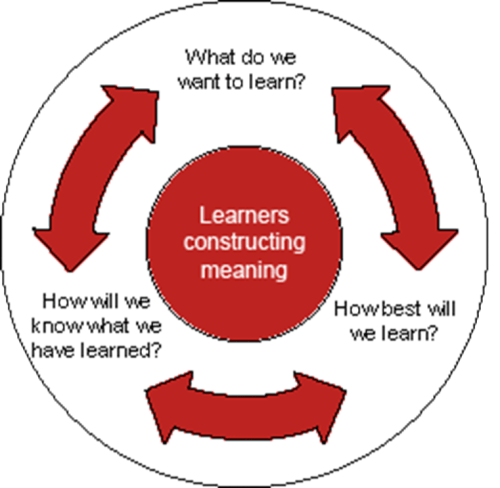
The Learner Cycle used at my previous school by all teachers and learners is personalised in classrooms to include:

What do I want/need to learn?

How  best will we/I learn?

How will I/ we know what we have learned?

learner-cycle

Personalising learning for each student is one way of avoiding learners comparing themselves. Planning learning goals is crucial and I’ll expand on this in another post.

The last point I would like to make is: 

The young learners starting their Foundation year already know a lot about learning. Our role as teachers is to help our learners make connections from what they already know to new learning. I’ve posted Piaget on Piaget and its worth looking at!

Cheers Nina

3 Comments

Filed under Uncategorized

Remembrance Day 2015: Weary Dunlop and the IB Learner Profile and attitudes.

Firstly, 2015 was a busy year so my posting was not as frequent as I would have liked. This didn’t stop me writing and recording my learning and my students’ learning. Many of my posts will be uploaded over the following weeks and cover a number of topics. My learners are 6,7 and 8 year’s old.

I’ve also taken a huge step and am no longer working in the Victorian state school system. Moving to inner Melbourne, Victoria in 2015 has meant the transit time to my previous school was unworkable long term. I will state that I was incredibly fortunate to work in an amazing school. However, I am equally excited to embrace new challenges in 2016, whatever they end up being!

Remembrance Day 2015 published on Australia Day 2016 to recognise a great Australian.

Each year our program includes the recognition of Remembrance Day. I start hunting for special picture story books appropriate to my students that will be used as launches for written responses. The books or poems chosen need to be displayed in the classroom for at least two weeks prior to being planned into the classroom program and read often. This enables young learners to develop a familiarity with the text, ask questions at home and collect further information if they choose.

071

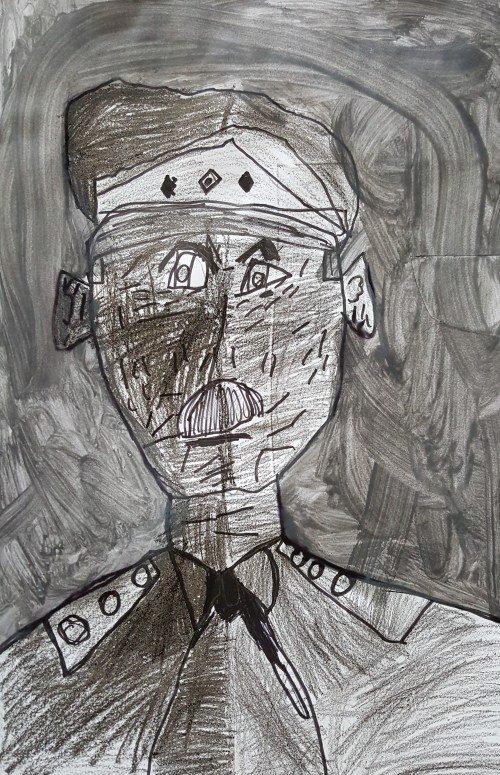
Providing an opportunity for young children to express themselves in many ways is crucial. My students were asked to create a portrait of Weary after listening to the text. We decided to limit the colors to show our feelings about this time of Weary’s life and use the illustrator’s front cover for inspiration.

077

Europe 2016 070

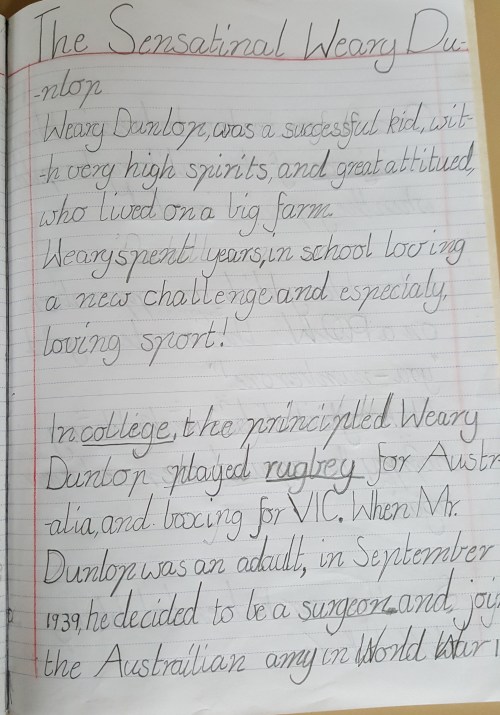
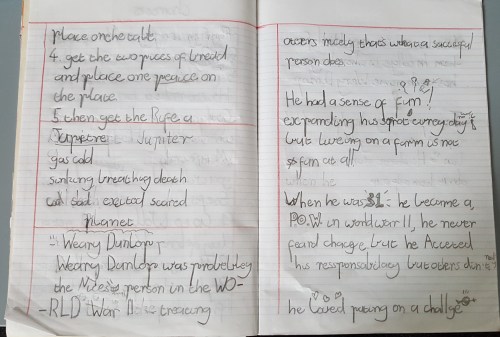
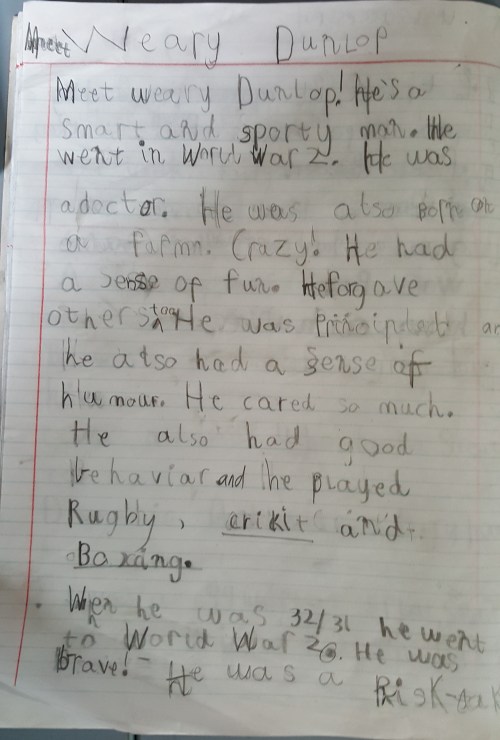
When reading their writing I was looking for links to the IB – Learner profile, attitudes and the traits of successful people. Although, I had not asked my students to make these links; I was hoping that they would. The Learner Profile and attitudes are naturally embedded into our daily discussions.

I’ve selected some random examples of my students work. Some learners have added their own elaborations to Weary’s experiences. You will notice that many of my students are using paragraphs without prompting. They also underline their spelling errors as they write and will make corrections after writing. My students know about paragraphs through an inquiry. They looked at paragraphs in books and developed their own criteria to assist them and others to use paragraphs. Some students are still experimenting with their use but are able to discuss where they could use them during a writing conference.

These young learners were also asked to think of a different heading for their response.

Europe 2016 078 (2)

Europe 2016 079 (2)

 Europe 2016 095 (2)

Europe 2016 093 (2)

Europe 2016 091 (2)

Cheers Nina

1 Comment

Filed under Uncategorized

IF is but a little word that sits in the corner!

438890-8b923612-fa4c-11e2-9254-133e1837b7ae

You may wonder how this post fits into education, but hopefully by the end you will see the link. Recently, my siblings and I had to put our mother into residential care. A huge challenge because although she knew she was no longer coping, she is an independent woman, ex Director of Nursing with post graduate studies in gerontology.

This is a complex journey for any family and if you are ever in this position you will understand that aged care is a minefield.

Firstly, the best advice I can give is find a consultant who will help you understand this system and help you find the right place for your parent.

Our parents took us to school on our first day and I have now taken my mother to her first day at her new place. So what does she want from this experience and what do I want for her?

My vision was a place where the aged are treated with dignity and respect. My mother deserves that. She is an intelligent woman who has worked hard to ensure the aged are recognised in our community. Equally when looking for a school, the best school is most likely the school that is closest to you, but if you’re not sure put some questions together, visit and ask!

My mother’s new residence meets 99 percent of anyone’s needs and it would be hard to get better than that!

Many parents are now wondering how their child will settle into school next year and if the school they have chosen will meet their child’s needs. Will my child make friends? Will the teacher help my child to settle in? What will my child do in such a big playground? How will my child react to other students less or more capable than he/she? So many questions and so many concerns… and as a teacher I understand each of these concerns. One, I’ve taken my two children to their first day of school and both survived! Two, I’m an experienced teacher and greeted many students on their first day of school. And they survived too!

Letting go of our children and older parents is similar. You have to be positive and resilient and build this in your child or older parent so they become confident in their new surroundings and routines. It’s difficult because you want to hold their hand, but you can’t always do that.

This might help: My grandmother had a little saying and it goes like this….

IF is but a little word that sits in the corner. If we worry about the IFs in the world, we won’t go further!

So let’s not worry about the IFs.

Cheers Nina


Leave a comment

Filed under Uncategorized

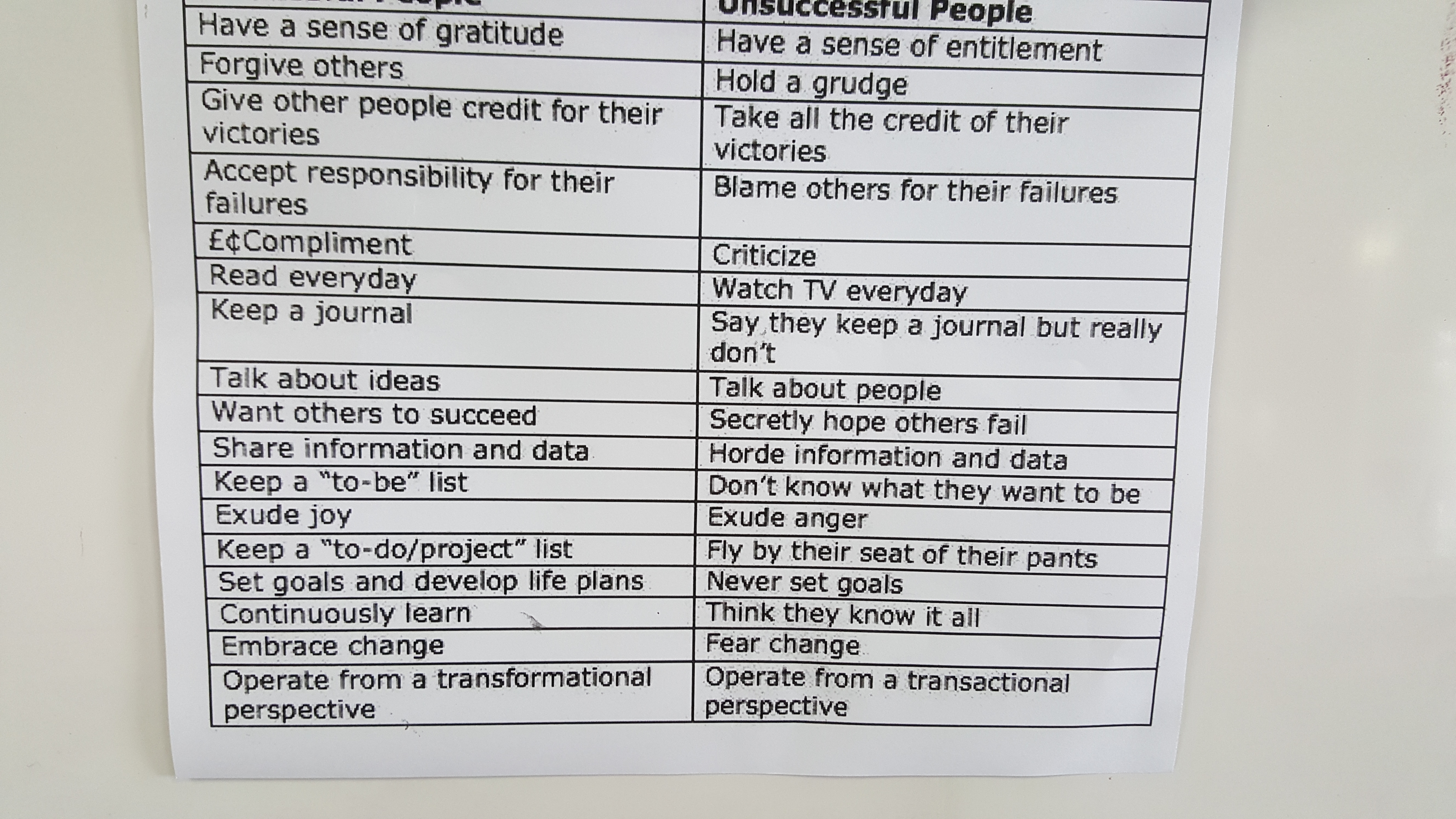
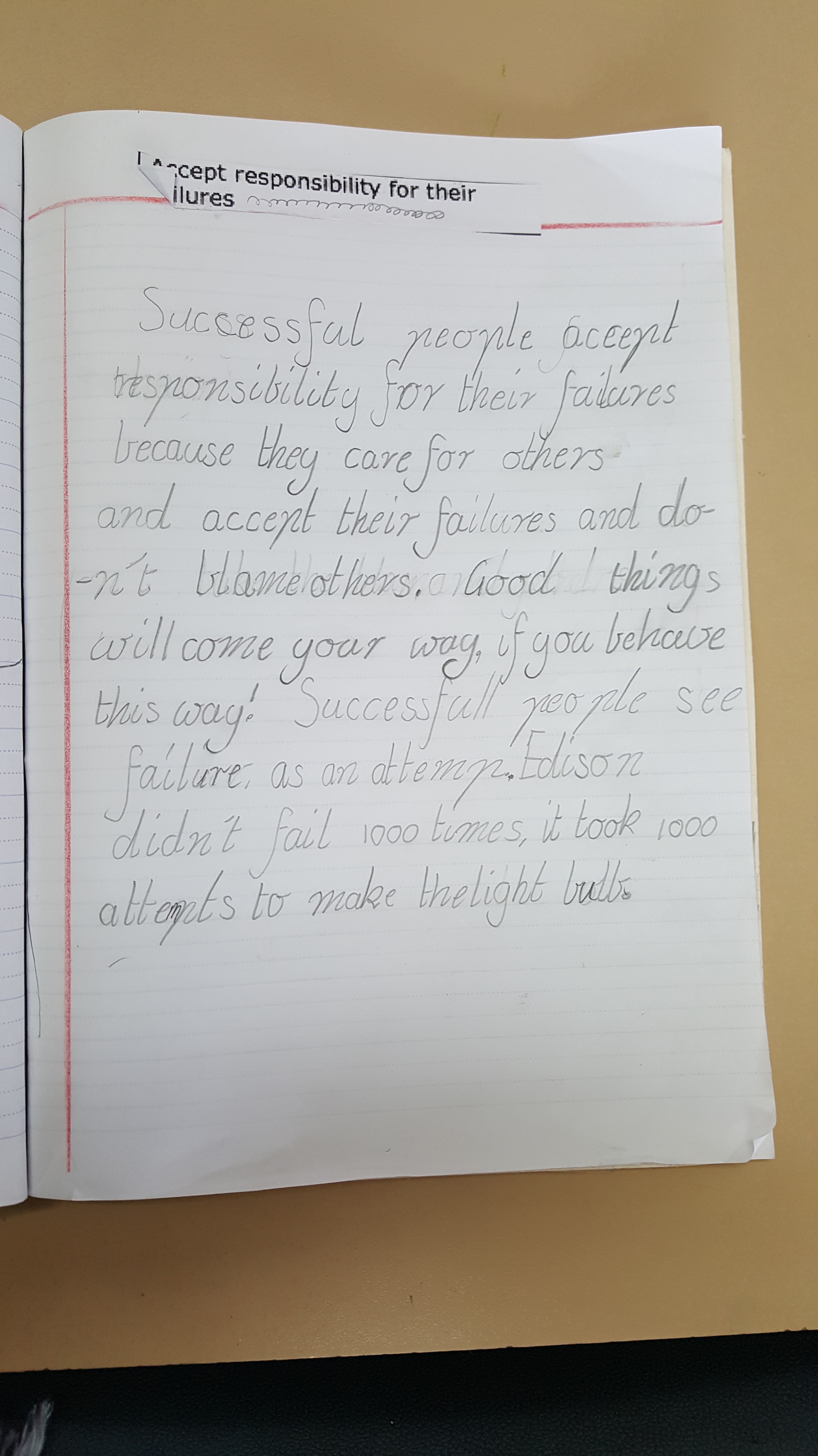
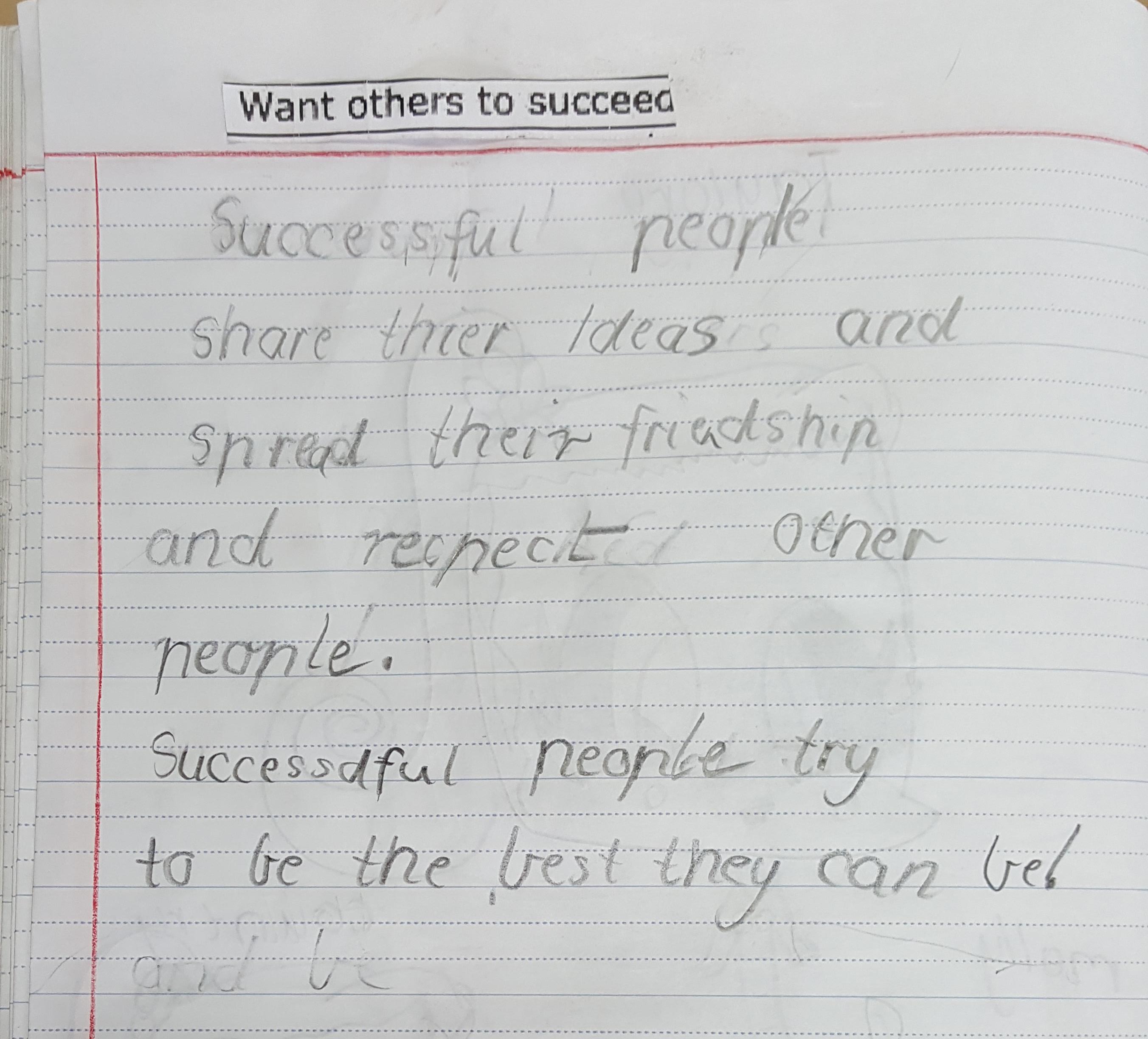
Successful people have certain behaviours: The IB Learner profile and its conection to the traits of a successful people. Year 1 and 2 students explore and respond!

Recently I was introduced to the traits of successful people compared to the traits of unsuccessful people. Having reviewed the traits myself, I decided to introduce this document to my students. My students are in Year 1 and 2 in Australia and very capable of looking at and discussing this document. My school is an International Baccalaureate (IB) school. The IB introduces students to the Learner Profile so my students already have an understanding of what being a successful learner and person encompasses. We are now unpacking the successful traits and connecting them to the IB Learner Profile and attitudes.

2015 FebMarchand ANZAC 086

20151023_151925

Link: http://www.workingmomsonly.com/2011/07/25/eliminate-the-jealousy-factor-and-success-will-follow/

6774_1296095207

My students discussed the traits and were given one trait to respond to and make connections to their life.

20151023_143344

20151023_143357

20151023_143418

20151023_143648

 20151023_143607

This is what I call thinker’s writing. The learners aren’t using a set genre and have to structure their own response. Many made connections to their own life. These are examples of first drafts written independently by my students.

Cheers Nina

6 Comments

Filed under Uncategorized

When you know you’ve met an inspirational education leader! Vale Dr. Elizabeth Mellor

Last week Australia lost a true advocate for early childhood education. Doctor Elizabeth Mellor was a passionate driver for improved early learning for children and much of her recent work was in this area.

Having completed many professional development courses, there is still one standout for me: The Leadership for Community Engagement Program. Elizabeth was a co-presenter and one of those educators you meet and sense instantly that you are in the presence of a leader!

What did I learn from Elizabeth and the course about leadership?

I’m calling it YOU!

You, as a leader, will be different to a manager, you will be finding solutions, you will use your courage and confidence to influence others, you will speak a common language and find that common language so you can move forward. You will empower others and be an enabler so you can shift barriers. You will encourage others to ‘think big’ and work towards delivering transformational change. You will coach others on how to measure change, be respectful and a listener so you understand and collaborate.

You will not shy from anything and you will get in and learn. You will empower others to solve problems because you can’t fix it all. You will take risks and from taking risks you will gain experience to put into other aspects of your role. You will give others a voice and act on what they want and work side by side with them to achieve your common goals. You will be capable of ‘unlearning’ and not be judgmental. You will build a ‘treasury’ of good practice to help you evaluate actions and capture what has been learnt so you can measure the impact of changes and improvements.

And finally, you will deliver to every child and family. Your flexibility will be key to you being a leader, as without flexibility you will impede innovation. You, as a leader, must leave the profession in a better state and by building the capacity of others you should do yourself out of a job!

august-photos-0234 (2)

Cheers Nina

4 Comments

Filed under Uncategorized

IB-PYP: Tell me and I forget. Teach me and I remember. Involve me and I learn. Benjamin Franklin – Inquiry is an approach to learning not a method.

Inquiry as a pedagogical approach is not a method of doing something. It is an approach to learning which is about posing questions. Inquiry starts with a question, wondering, problem or idea which engages learners into investigation, the creation of knowledge and testing of what they know.

IMG_3735

Recently, a group of young learners ( 7 & 8 year old students)  asked me if they could spend time on their personal inquiry. Naturally I was excited that this group were personally motivated and wanted time dedicated. I decided to watch their progress and photograph their work. I also made a conscious decision to sit back and evaluate their use, and my teaching of the school’s Inquiry Process.

This group of young learners surprised me by their understanding of the process. They set about planning, focussing and preparing their inquiry. They were developing a central idea and had created a list of wonderings.  They wrote what they called a big wonder (How do wars start?) and had a number of key questions, some which they said they will park in the Parking Lot. The Parking Lot is a place where questions and wonderings are placed that are not part of the focus but may be answered later or as part of their learning.

IMG_3736

They discussed their questions individually and chose the big questions they wanted to investigate. Then they talked about how they would find information (Finding Information). I was impressed by their confidence and ability to talk about each part of the process.

This is where the learning process results in true Learner Agency- student choice, student responsibility for learning and actions, a meaningful curriculum and learning initiated by learners.

Cheers Nina

1 Comment

Filed under Uncategorized

IB-PYP: Maps – Gathering prior knowledge: Show me the way to your home from school. What did I learn? I should have known more about this student!

We’re learning about maps so I asked my students to show their way home from school. They could choose how they would show their journey. One of my students started drawing…. What did I learn? I know that how we ask children to show what they know is incredibly important and when gathering prior knowledge we can’t assume what a child knows. One of my very quiet 7 year old students started drawing their map.

school ) 006

school ) 013

Kids and Graham Morgan Senior 014

Can I find the way to my student’s home? YES How did this student know what they know? Would I have discovered what I now know about this student and their thinking if I’d presented my initial question a different way? QUESTIONS!

Cheers Nina

4 Comments

Filed under Uncategorized

The IB – PYP: That’s where we’ll hang our hat! Part 1 – At the grass roots…

This is the year of the circle.

My father always said children need something to hang their hat on and something bigger than them.

So what does this mean in terms of learning? Schools are our young peoples’ community, something bigger than them and where they can hang their hat. Primary schools exist for young learners, but they are also children (so keep that thought). A school has a greater responsibility than just teaching the 3Rs. Schools are where our young people learn about relationships, community and develop a sense of self.

My school is an IB-PYP school. So why be an IB school? It’s a question I’ve thought about for some time and relates to what my father told me. Children need something greater than themselves and so does a school! Schools are an important part of their local community, but where does a school hang its hat and be part of something bigger than it?

Example 1. Developing a sense of community: The IB Learner Profile.

The IB has developed a framework known as the Learner Profile. The Learner Profile relates to all learners, teachers, administrators and wider community members. The IB Learner Profile recognizes the broad needs of young learners and young people across the world.

learner-profile-en

6774_1296095207

Let’s take a look at the IB – PYP at the grass roots – my Australian Year 1-2 classroom…

Example 2. Developing a sense of community: Being part of something bigger.

My students understand that we are a team and being part of a team has associated responsibilities. Our team is part of the school community, local community, government education system and IB World Community. Young learners (6, 7 & 8 year olds) need to grow their understanding of responsibility by being part of a community and the classroom is where they start.

Two Simple Diagrams:

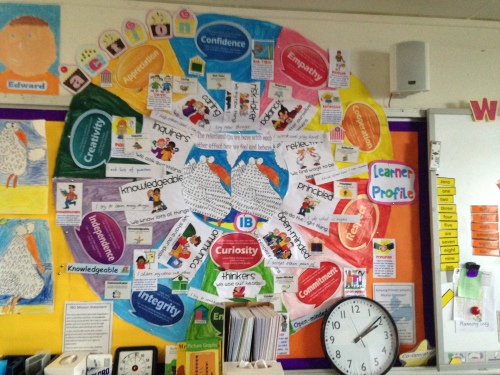
Two simple diagrams underpin my students’ learning about being part of a team and managing relationships.  I bring everything back to the IB Learner Profile and attitudes. The picture below is our Learner Profile circle and ‘working wall’.
2015 FebMarchand ANZAC 086

The learner Profile represents our classroom essential agreements. My students know that as learners we make mistakes and learn from them, however, they also understand that being a member of the team is about demonstrating the Learner Profile through our actions. The Learner Profile is part of our daily learning. It’s not just a pretty display, it is a living and growing record of our growth as learners and young people.

Diagram One: The Team Circle

Sometimes someone may not have exhibited the Learner Profile and as a consequence moves to the side of the team. The young learner then has to develop the trust of the team to move back. Being a member of the team is very important to these young learners and they are incredibly supportive of each other. It has become a very positive approach to classroom management. It would require another post to explain how students learning self management is powerful for their confidence and learning.

Diagram two: Friendships and relationships

This one was developed to show how ‘he said, she said’ works. Two friends have an argument and involve others and rarely, but sometimes parents get involved. However, by the time the two best friends have sorted their differences, the outside circles are still arguing! This is where we learn CHOICE and my students are now thinking about the choices they make. They will help sort out problems but rarely become part of the problem. They are incredibly mature and honest! Simple diagrams but visible…

circle 002

Cheers Nina

1 Comment

Filed under Uncategorized