Category Archives: Uncategorized

The Dolphin Research Centre: Exploring the rockpools at our local beach with Ben 10.

It’s a ten minute walk down to the beach from my school and how lucky we are to have this wonderful environment at our door step. Ben from the Dolphin Research Centre is passionate about our bay and his knowledge of the creatures that live there is amazing. Our students are very fortunate to have the opportunity to listen and explore with Ben. Ben introduces life in the rock pool, explains how to explore rock pools safely and how these amazing water spaces support small creatures. The children are totally engaged and have returned to school with many wonderings to explore and answer.

I’ll be following our rock pooling adventure with a Student Led Interactive Writing session. Our focus will be using adjectives and joining words. Keep visiting!

Cheers Nina

Leave a comment

Filed under Uncategorized

Prep (5&6 Year Olds) writing- What a journey!

Student Led Interactive Writing and small group Teacher Led Interactive Writing are the best scaffolding strategies for writing in my opinion. However, I can evidence this by the development of my Prep student’s (5&6 Year Olds in Australia) writing this year. These strategies are intrinsic to the Language Experience Approach. If you type Interactive Writing into the search box in this blog, you’ll be able to see the many posts I’ve written about this strategy this year.

 ‘Interactive writing involves the teacher and small groups of students jointly composing a large print text on a subject of interest to the students and sharing responsibility for the recording at various points in the writing. Teachers quickly record the words that students know how to write, and engage students in problem solving and recording the words that provide challenges and opportunities for new learning. This eases the transition to independent writing by: • making explicit how written language works • constructing words using orthographic and phonological knowledge • producing a text that can be read again.’ Sofweb

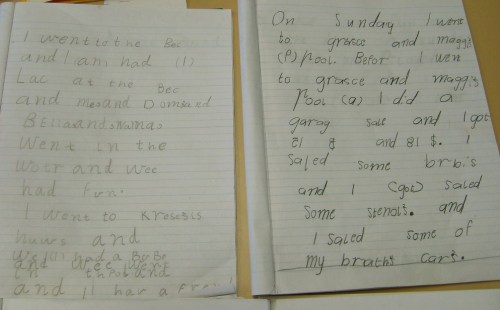
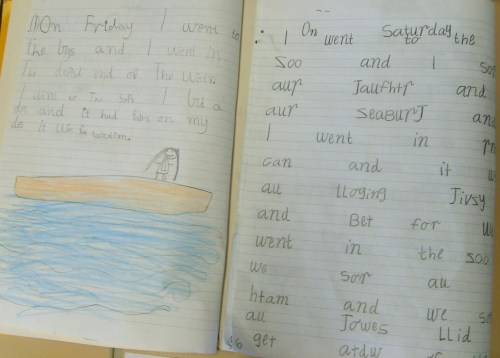
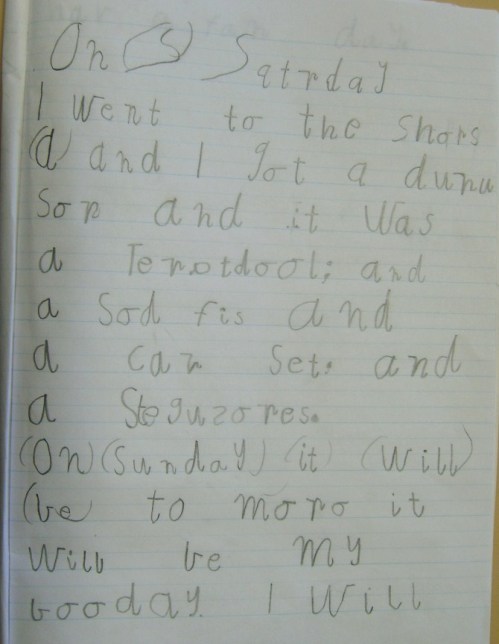
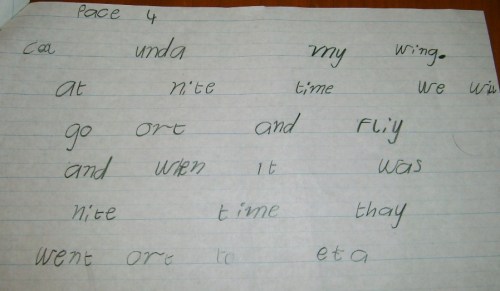
Taking this strategy to the next level – student led has also had an enormous impact, as the students have complete responsibility for the composition and organization of their text. They know how to prompt and use strategies normally used by the teacher. Handing over the responsibility always has its concerns; however, working in groups where cooperation is essential is important for young children. I have included pictures of today’s journal writing. I can see the transfer of  explicit teaching, which is something I’m  always on the look out for. Today in our focus discussion prior to writing, it struck me just how much these children now know. The children also guide our focus choice, and today one child asked if they could have the ‘apostrophe of ownership’ explained again. Wow!

S5006679

S5006680

S5006682

S5006684

S5006685

S5006687

 I have included only one page from each of these children. Some children wrote four pages of organised text while most wrote one or two pages. Editing has become  a natural part of the writing process and to the support the children they have a writing checklist that they use each time they write. This checklist was formed by the children after extensively looking at good writing samples.

I have included many samples here. These samples display the skill range in my grade and have been randomly chosen.

Cheers Nina ( Still writing reports)

2 Comments

Filed under Uncategorized

If I were wearing her shoes now… my 4th Year Intern is employed!

I am posting this news, because I’m just so thrilled for Jacinta Matheson, my 4th Year Intern for ‘putting her hat in the ring’ and being a successful applicant for a teaching position. Jacinta will start her first teaching job at a school not too far away from mine in 2010.

S5005901

Jacinta has been outstanding in every way and has featured in this blog numerous times. It has been such a pleasure working with her this year. This has been a relationship where learner and mentor have learnt together. I feel a bit like a mother bird here, but Jacinta is more than ready to leave the nest and fly on her own, infact I think she’ll soar.

My advice to Jacinta has been the same advice I’ve given to my Preps. That is, grab every opportunity you can, be a part of everything, contribute and learn. I’ve also given advice that I haven’t shared with my Preps and that is don’t make the mistakes I have. Jacinta has the capabilities and personality traits needed to be a school leader in the future. She may not want this for sometime, but it will happen…and I may have to go crawling to Jacinta for a job one day, so Jacinta when you read this, remember to be kind!

Cheers Nina

P.S I still expect you to read my blog next year. Ha!

2 Comments

Filed under Uncategorized

I’m TPL-ing: Teacher Professional Leave 2010 – We’re off and racing in Victoria!

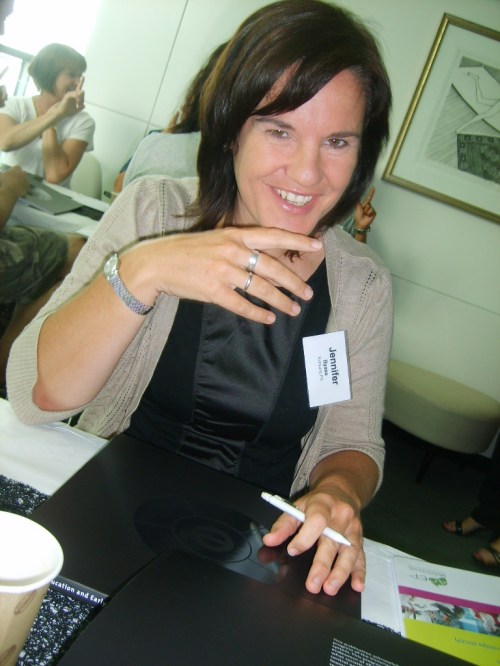
Today was the first Teacher Professional Leave Team Day and its come along at the right time in my career. Engaging and conversing with a new group of educators from different settings is always refreshing and something we don’t do enough. My TPL partner Jenni and I took the train to the city and arrived at our destination for the day… and  we were not disappointed. Looking out over the city from an amazing penthouse apartment redesigned into a very comfortable work space set the scene for an informative and engaging day…and lunch, well that’s another post.  Amazing!

 S5006671

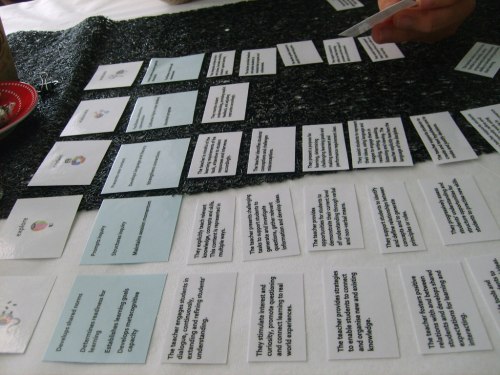
On a serious note, Day 1 really made us appreciate how fortunate we are to be involved in this program. After reflecting upon why we initially applied for TPL, we started to discover what the e5 Instructional Model represents. 
S5006675

We were also given our very own copies of the ‘e5 Black Album’ (the complete e5 Instructional Model manual) ,so I’ll be referring to it here. We’ve all had one of those ‘ah ha’ moments when past knowledge and new knowledge combine to form a new understanding, well, I think we had one of those moments.  This new knowledge will now guide our inquiry into best teacher practice.
 S5006672

The e5 Instructional Model is about describing and recognising what teachers do in classrooms which engage students in quality teaching and learning. Quality transactions between teacher and student significantly improves  student learning outcomes and this has been well researched. We need to have an understanding of what this looks like, feels like and sounds like in action.

S5006673

Darrell Frazer, Deputy Secretary, Office for Government School Education articulates this well in ‘The Black Album’ . He states:

‘In order to improve teacher practice, teachers must not only understand what it looks like to improve in different domains of learning, but they must also believe they are capable of improving their practice.’

‘The e5 Instructional Model is not a recipe for teacher practice but rather a framework to inform conversations and guide the observation, critique and reflection of classroom practice. ‘

‘I invite every educator to engage with the e5 Instructional Model as a framework for defining what high quality instruction looks like in the Victorian government education system.’

Another powerful quote contained in this document has been taken from Elmore 2004, School Reform from the Inside Out (Harvard Education Press, Cambridge, MA)

‘Over the long term it is impossible to improve student performance without eventually improving  the quality of teaching and learning that occurs in classrooms and schools.’

Over the weeks to come I’ll be researching and writing about the e5 Instructional Model in detail and outlining our TPL inquiry. Thank you to our presenters Kaye Fletcher, Jennifer Gervasoni and Catharine Kleinitz for a terrific day.

Cheers Nina

Upcoming Post: A 5 Year Old’s  Journey into Literacy: Mapped for a Year- An Interwoven Weave.

2 Comments

Filed under Uncategorized

Gillard Discusses Education Changes…

Australian Broadcasting Corporation

Broadcast: 11/11/2009

Reporter: Tony Jones

 ‘The Deputy Prime Minister and Education Minister, Julia Gillard, joins Lateline to discuss the Governments self-proclaimed education revolution.’

 ‘And Tony, of course, we’re also making profound reforms on the question of teacher quality and school leadership. We understand the most important thing to learning is the transaction between a teacher and a student, and if we can increase the quality of that, we can increase what’s happening quality-wise in our schools. That’s why, once again, we’re investing more than half a billion dollars in improving teacher quality and school leadership, including some reforms people thought this country would never see.’

 Now this is interesting! Julia Gillard has made a point here that I totally agree with and I think we’ve known for a long time. What makes a difference is the transaction between teacher and student. Improving teaching and learning in classrooms will ‘increase what’s happening quality –wise in our schools’. I agree!

 ‘Our new reforms for teacher quality have already started to deliver in NSW a system where a teacher can accredit as a leading or accomplished teacher, a teacher with special skills and they will be paid six figure salaries to go to disadvantaged schools to teach in those classrooms that need them the most because the kids are most at risk of falling behind – literacy and numeracy and the educational benchmarks we need them to attain.’

 Ok, so where am I going? To become a Leading Teacher in a Victorian school is near impossible. There just aren’t many positions, and if you want your speciality to be teaching and learning in a classroom, because that’s what you love to do, then it’s even harder. This  makes sense and I sincerely hope this happens. Lets value quality classroom teachers and give them access to promotion.

 I’m not so sure about other issues brought up in this interview, because I really need to know more, but I felt a ‘tinge’ of hope when I read this. All students, regardless of demographics have a right to reach their potential, to be literate and numerate. Australia is not third world, we have no excuse.

Cheers Nina  Come on, share your thoughts with me! Follow the link to read the full transcript – it’s interesting reading…

Leave a comment

Filed under Uncategorized

Butterfly Patterns & Symmetry – just amazing!

S5006622S5006620

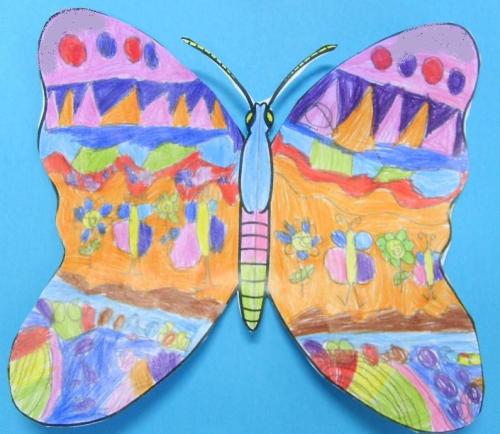
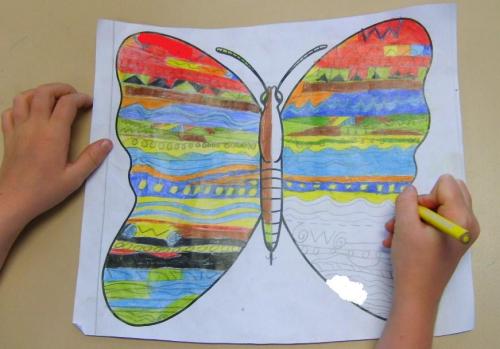
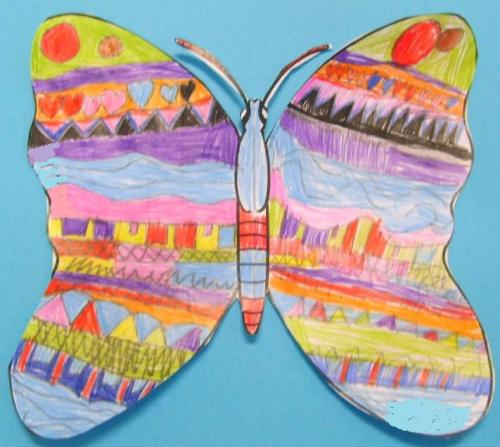
My Preps have been learning about patterns and symmetry in nature. Each child was given a butterfly outline and asked to create a pattern on one half of their butterfly. They had to plan their pattern in grey lead and then brightly color their design. When they had finished their side of the butterfly, it was named and passed to another child who had to match the existing pattern. The children loved this activity and the results are stunning. I’ve included photos of their work and one must remember this is the work of 5 & 6-year-old children. We’ll be visiting symmetry again, but ‘hey’, they’re beautiful anyway.

S5006629

S5006631

 S5006624

 S5006626

S5006627

Cheers Nina

3 Comments

Filed under Uncategorized

‘Media literacy education should not be seen as just another burden on an already crowded curriclum.’ Dr Patricia Edgar – Now that makes sense!

I have been reading an article written by Dr Patricia Edgar and I’ve decided to share what I believe are her key beliefs and what I found reaffirming. What caught my eye was this statement: ‘Media literacy education should not be seen as just another burden on an already crowded curriculum.’

I’ve been hearing this a bit lately and I’m beginning to think that many teachers feel so over whelmed by Web 2.0 that they don’t take that first step, asking someone for help.  I’m using the statement, ‘From Little Things, Big Things Grow’ a lot lately, because it sums up my learning experience and one I’m now sharing with others.  Web 2.0 for me has been about baby steps and a mentor. I have immersed myself in everything, made mistakes along the way and grown professionally. I’m far more patient which has been an interesting outcome from my experience. I actually understand how hard that first step is.

The key points I have taken from this article are:

  • ‘We now live in the information age with young digital natives accepting digital technology as casually as we did pencil and paper.
  • Media literacy education should not be seen as just another burden on an already crowded curriculum, using technology effectively is fundamental to life today as traditional literacy skills.
  • Experts are calling for media literacy in four main areas, covering children’s ability to: access the media; understand the media they access; create their own media content and learn through the media-
  • Building on media content to enhance learning.
  • As children are spending more and more time online, education policy needs to embrace the positive potential media offer
  • Incorporating what students are doing into the school curriculum holds the promise of keeping students engaged in learning. ‘ 

Any statement relating to student engagement always grabs my attention because we all know students who aren’t engaged will not maximise their potential.

Dr Patricia Edgar’s latest book is The New Child: In search of smarter grown-ups.  

S5006118

I’ts report writing time, but I’m still hoping to post regularly. Thanks for the comments and e-mails. I hope you find Dr Edgar’s ideas as  interesting as I have.

Cheers Nina

Leave a comment

Filed under Uncategorized

Consultation & Quality Leadership – What makes a ‘great’ school ‘great’?

Yesterday I went to the DEEM briefing outlining how to read school survey data related to Drug Education and Student Wellbeing. I went last year and was wondering if this session would be a repeat of last year. However, this year we spent quite a bit of time looking at school leadership.  Leadership models were introduced and as I haven’t really done much leadership PD, it was all new. I actually found this aspect of the briefing really interesting.

When looking at the data, the key points highlighted for me was that everything goes back to quality teaching, engaging programs and effective leadership. You can have an ‘OK’ school, but when you have all three combined you’ll have a ‘great’ school. Research also says engaged students, quality programs, effective teachers and good leadership results in improved school learning data.

S5006611

This is my notes from yesterday’s briefing. It shows three models of consultation/leadership. The first model shown has squiggly lines that go nowhere. This represents talking and never getting anywhere or making a decision. The second model represents following the steps 1-2-3… or just doing the process. The model represents change that is totally driven with no reflection. The third model displays learning. It’s a curving line that goes from a to b. Decisions are made and consultation has happened.

 S5006613

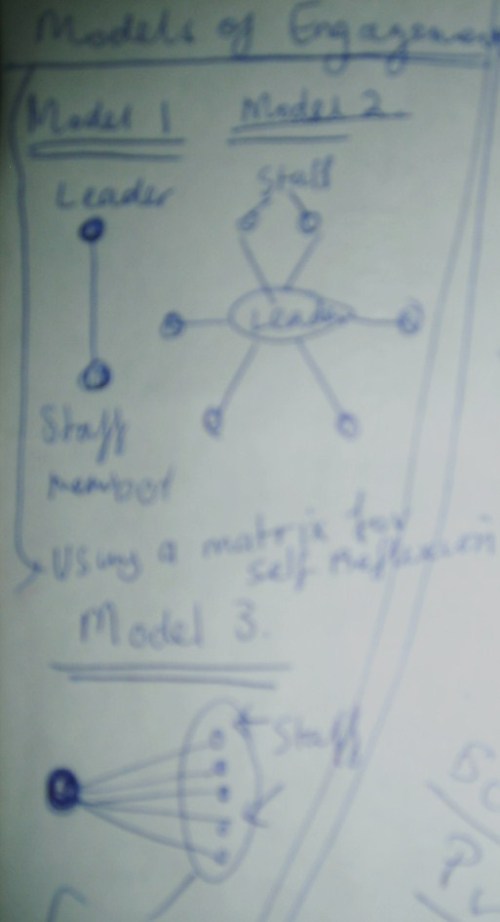
Sorry about the photo quality but I’ll explain each. These are consultation models. The first one shows a straight line from the leader to the staff members. This represents no consultation and is an autocratic leadership model. The second consultation model displays the leader in the centre and the staff around the outside. The leader basically goes off to different staff members indivdually and asks each their view on something and then reports what was said to the next staff member. Most staff in this model agree with the leader who can direct the responses. The third and most successful consultation model has the leader talking to a group of staff, brainstorming, discussing and asking for feedback. Throughout my career, I’ve seen each of these models in play and am familliar with all.

What have I learnt? I’ve learnt that quality leaders consult well and make informed decisions and that quality leadership is essential for a ‘great’ school. Thanks Lynne and Donna for an informing morning. And to all you leaders out there… What type of consultation model do you really use?

Cheers Nina

2 Comments

Filed under Uncategorized

Using my student’s writing to inform teaching and learning. Where do we go from here?

Angela Stockman ( a Literacy Coach in America) left a great comment on my last post asking me what I have taken away from the children’s writing which will inform program planning. I decided to write a post identifying the learning needs of my children. These needs will direct my planning.

Where do we go from here?

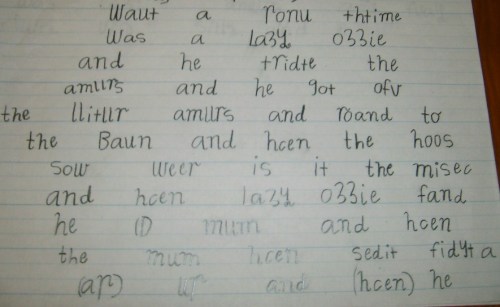
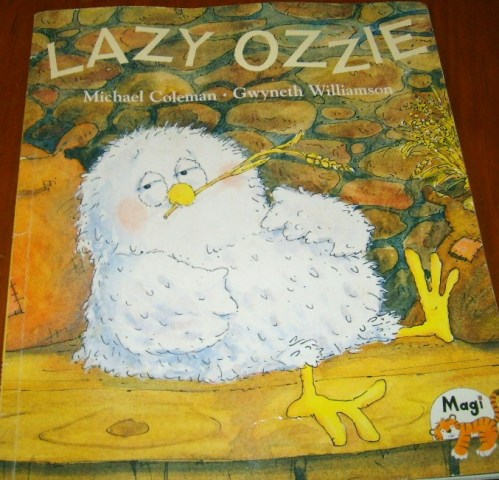
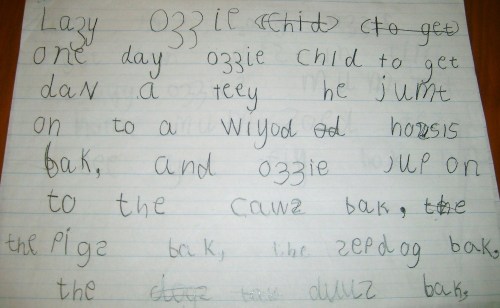
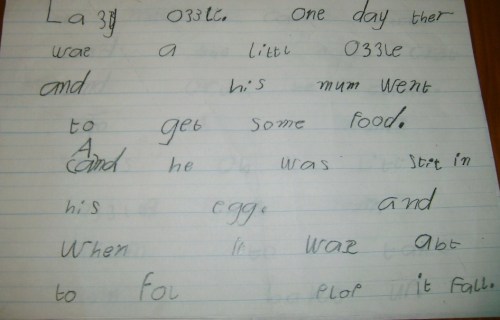
I have just reviewed my class writing samples based on the story Lazy Ozzie. There are a number of teaching needs that appear to be consistent across my grade. These teaching needs will direct my next fortnight’s whole class focus segments, where key learning needs are explicitly taught. Other learning needs will be taught to small groups of children needing extension or groups needing to revisit simple key skills and concepts. I also spend part of each writing session roving and working with individual students ‘at their point of need’. A number of my identified needs will be addressed during reading activities.

The Learning Needs:

Conventions of Spelling

  • Frequently occurring patterns of letters such as ‘ing’, ‘ow’, ‘ou’, ‘er’
  • Using more complex phonic conventions to spell words e.g. words that have the same sound pattern.
  • Looking at words with particular sounds e.g  farm, off, photo
  • Introduce common contractions- his, he’s, did not, didn’t  etc…
  • Review consonant diagraphs – ‘tr’, ‘ck’, ‘th’, ‘sh’
  • Ck Rule- Use a ‘ck’ when it follows a short sound of the vowels e.g. duck
  • Magic ‘e’ -When you have a word like mice the ‘e’ makes the word say its second sound e.g. cage
  • Ed & ing- If the last three letters of the base word are consonant-vowel-consonant double the last consonant before you add an ending that begins with a vowel e.g. swimming

 Writing Strategies

  • Continue to have students read back writing  ‘at the time of writing’ and at a later date
  • Checking writing for correct letter formation, spaces between words, use of full stops
  • Using commas, e.g. on the horse, on the cow – and lists
  • Reading writing to others  and reading back to self to make sure their writing makes sense
  • Checking spelling to make sure known sight words are correct
  • Continue using a simple plan – thinking about what I want to write, clearly defining a topic, adding detail to a topic, understanding concept of first draft, sequencing ideas to make sure they have a beginning, body and end using the ‘hamburger model’.

 Ideas Communicated in Writing

  • Expressing an opinion
  • Using high frequency words relevant to the topic – vocabulary building
  • Using a dictionary, creating personal dictionaries for our Inquiry topic
  • Identifying the main idea and subordinate ideas in texts.
  • Writing multiple sentences that relate to a chosen topic – Inquiry topic

 S5006606

I’ve asked Angela to look at my identified teaching and learning needs and add anything she thinks I have missed and there will be many. I’m always looking for feedback as I see myself as a learner and I often think I’m missing something obvious. I’d love to work with a coach.

Cheers Nina

4 Comments

Filed under Uncategorized

Lazy Ozzie – Extending writing: Building oral language is crucial to writing development!

S5006593

My Preps (5&6 year olds) have been using strategies to extend their writing. I read the wonderful story about Lazy Ozzie to them this week. It’s a repetitive text combined with a story. Just perfect for this task. The children were asked to retell the story read to them or write their own Lazy Ozzie story. I’ve been doing this activity since the beginning of the year and I’m thrilled with their efforts. I’m a huge supporter of Language Experience and believe that this approach/philosophy about how children learn has extended the ability of all children. I don’t believe it’s this cohort, as the writing of so many children in my grade is wonderful. Their reading and writing has developed from activities implemented daily which build oral language. Interactive writing, both student led and teacher led has also played a huge role and is one of the main strategies of the Language Experience approach.

Student 1.

S5006594

S5006595

S5006596

S5006597

Student 2.

S5006598

S5006599

Student 3.

S5006600

S5006601

S5006602

S5006603

Student 4.

S5006604

S5006605

I could keep on posting my children’s writing samples because they are wonderful.  If you have time read my previous posts from the beginning of the year and you’ll see how their writing has developed and the scaffolding strategies used a long the way. 

Cheers Nina 

P.S  I also am amazed that editing has become a natural part of the writing process for many of my students.

4 Comments

Filed under Uncategorized