Category Archives: Uncategorized

Victorian Fires: Working Together 2 Make A Difference – A Ning! What’s That?

I’ve recently joined a NING- I’m learning again! This NING is special. I encourage all readers of this post to visit Working Together 2 Make A Difference and see what ‘educators working collaboratively’ is all about.

Working Together 2 Make A Difference

What is it?  Jenny Luca explains:

Background-

‘As educators, we try to encourage our students to see past themselves and take a wider world view. Depending on many factors, that can be relatively easy, or relatively hard. As we approach the festive season for many cultures, an opportunity presents for us to have a means of working together in a collaborative fashion to have our students realise that their efforts can be far reaching and effect others.25 days to make a difference has detailed her efforts to raise funds for various charity organisations throughout the year. She has had over 54,000 hits on her blog and has received media attention for her efforts. Now it’s time to let Laura know how her efforts have inspired others to do the same.

11 Year old Laura Stockman has been a source of inspiration for many throughout 2008 and now into 2009. Her blog, 11 Year old Laura Stockman has been a source of inspiration for many throughout 2008 and now into 2009. Her blog, 25 days to make a difference has detailed her efforts to raise funds for various charity organisations throughout the year. She has had over 54,000 hits on her blog and has received media attention for her efforts. Now it’s time to let Laura know how her efforts have inspired others to do the same.
The aim of this space is to detail the efforts of educators and their students who are doing their bit to think outside of themselves and raise funds for worthy causes. We encourage you to join this space, create a new page for your school and start detailing what you and your students are aiming to do to help others less fortunate than yourselves. Chart your progress on your page and we’ll see what we can achieve by working together to make a difference.

We originally set Dec. 15th 2008 as our end point for this ning site. We have realised that educators are finding this page via a variety of mediums and we are more than happy to keep it open and extending into 2009. Let’s see what we can achieve!

Laura has shown us that one person can make a difference. Let’s see what the sum total of all of us working together can achieve.

‘Victoria, the State I live in in Australia, has been hit by a tragic natural disaster that is affecting the lives of many of our country communities. On Saturday the 7th of Feb., bushfires, fanned by fierce northerly winds in 46 degree celcius temperatures, ravaged our countryside, leading to the deaths of 173 people. This figure is expected to rise to over 200 in the coming days as they gain access to affected areas and search homes. Native animals, livestock and family pets were other victims of this disaster.Sheryl Nussbaum Beach and some words of wisdom from Clarence Fisher, we’ll be setting up a paypal account to direct funds you raise to the Red Cross appeal that has been set up to support those affected. Create a page here and let us know your plans. We can support one another and link our schools to a common cause. Let’s show the world how the education community can use the tools at our disposal to connect and support one another for a common purpose.’

So how can we all make a difference? We would love to see our education community from near and far band together to support the communities in need. What is needed is money to help schools rebuild, families rebuild their lost homes and for communities to build the infrastructure needed that has been lost in these fires.

What can you do? Anything that will help your students to understand the need to help others when the situation is dire. Be it a sausage sizzle, free dress day, bake sale, whatever it takes to raise a few dollars that can be used to support others. In the next few days, with the help of Sheryl Nussbaum Beach and some words of wisdom from Clarence Fisher, we’ll be setting up a paypal account to direct funds you raise to the Red Cross appeal that has been set up to support those affected. Create a page here and let us know your plans. We can support one another and link our schools to a common cause. Let’s show the world how the education community can use the tools at our disposal to connect and support one another for a common purpose.

As I explained earlier, my ‘learning curve’ at present is huge and I’m beginning to comprehend just how important my this journey is.

Cheers Nina

Leave a comment

Filed under Uncategorized

Language Experience: Introducing Language Experience in a Prep Class!

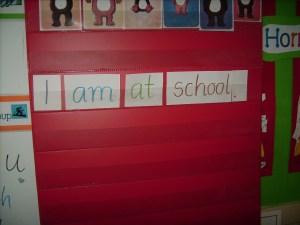
I’m excited and my Preps are reading! Below is a picture of our first sentence strip story board for the school year. As I mentioned in an earlier post, Australian schools have just started the new school year, so we’re at the BEGINNING!

As a class, we talked about what school ‘looks like – feels like & sounds like’ and from our discussion the children derived sentences about school. We built up our simple sentence story over two days.

We read our sentence board story over and over, we looked at letters, discovered what a full stop is and does and we’ve noticed that there are big and small letters. We looked at the sound ‘a’ and the children learnt how to write this letter. Language Experience stories are fantastic for teaching beginner readers. The sentence strip board is an absolute must and was included in my Top 10 Resources (previous post).


blog-photos-004


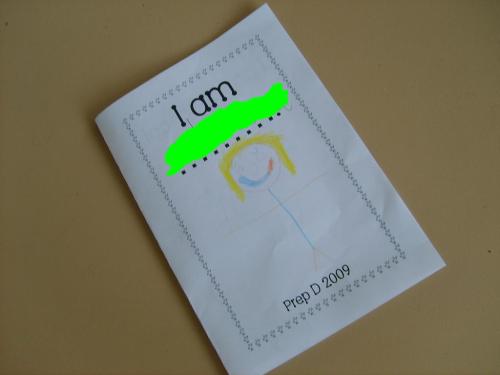
This was made into a class ‘little book’ for the children to read and illustrate. As we only had two working days, we will practice our book next week for a couple of days. It will then become a ‘take home’ book and because the children have complete ownership of the language and have illustrated their book, they are confidently reading it.

As we’re ready to write our next sentence story, these cards will be removed and pasted onto a poster for future reading. We will continue to read our sentence stories over and over. Success builds success and this model works!


blog-photos-0052

blog-photos-0061

Just a quick post. Hope you find it interesting. Cheers Nina

Leave a comment

Filed under Uncategorized

Guided Reading- From one Teacher to Another: Guided Reading in an Early Year’s Classroom!

I’ve had a number of teachers make contact looking for support and my advice is as follows:

1.      Read my blog!

2.      Visit other grades and watch a number of Guided Reading sessions and then most IMPORTANTLY ask to be coached! You need to ‘do’ to grow, not just watch someone else model, however, that’s a great place to start! I’ve coached others and been coached myself!

3.      Visit Utube and watch Guided Reading videos. There are many terrific videos made by real teachers for teachers.

Background – My Program

There are a lot of different views about when students should start Guided Reading or ‘what’ can be called Guided Reading. I am a purest, and by this I mean I follow the Guided Reading Model as outlined in the Early Year’s program, but feel free to call what you do, what you want!

As stated in my previous blogs, I do not start Guided Reading with students until they can read a RR Level 3 book at an instructional level. This does not mean that my students don’t read in groups, they do, I just call it Shared Reading or a ‘Round Robin’.

It’s my belief that children need to know a lot about ‘how books work’ before tackling Guided Reading. Developing oral language via Language Experience is where I start.

Children need to have the basic ‘Concept’s of Print‘ in place and I teach this via Shared Big Books, Round Robin and shared small book reading. We’re in training for Guided Reading from the beginning of the year. Children are taught at their ‘point of need’, so groupings are flexible and change according to student needs.

To stop children comparing themselves against others, I don’t call my groups colours or names. My groups are: My Group (teaching group on day), This Group, That Group, The Other Group & Your Group. Sounds confusing, however, it works and I’m into ‘things’ that work. Each group sign has a little icon and that stops me from being confused! It’s also really important that young children and parents value the learning process more than the reading level.

When bringing a group of children to the floor I like to use their names as it’s more ‘about them’. Grouping children according to assessment is another post itself, making groups seems easy, but if you want to maximise student learning and accelerate reading development its quite complex and requires detailed assessment. It’s simply not putting children reading around the same RR level together. (Another post coming soon) However, I will mention the following crucial assessment tip.

Important Strategy for forming Groups:

It is important that you keep completing Running Records on students until you find their first Hard level, and then drop back to their last Instructional level. This is their level for Guided Reading. There is often confusion among teachers about, what a child’s actual Running Record instructional level is? If this doesn’t make sense I’ll explain all in another post.

 Guided reading- Explained – A Teacher’s Explanation!

‘The goal of guided reading is for students to use (reading) strategies independently on their way to becoming fluent, skilled readers.

The steps for a guided reading lesson are:

Before reading: Set the purpose for reading, introduce vocabulary, make predictions, talk about the strategies good readers use.

During reading: Guide students as they read, provide wait time, give prompts or clues as needed by individual students, such as “Try that again. Does that make sense? Look at how the word begins.”

After reading: Strengthen comprehension skills and provide praise for strategies used by students during the reading.’

Extract:

Guided Reading: Good First Teaching for All Children by Irene C. Fountas and Gay Su Pinnell. Heinemann Publishers, 1996

Guided reading
‘The teacher guides students as they read, talk and think their way through a text. The teacher selects a text at the students’ instructional level, prepares the group for reading by establishing prior knowledge of the topic or text types, and briefly introduces the text then guides the students through it. Periods of independent reading are followed by discussion and teaching. Central to a guided reading session are the interactions between the group members.


Steps:

●The teacher becomes familiar with the text prior to taking a guided reading session.

●Select an appropriate text: unseen texts are generally used.

●Students require an individual copy of the text. Texts should be selected at the students’ instructional level, i.e. one that the students cannot yet read independently.

●The teacher identifies the supports and challenges in the text and selects teaching focuses based on the students’ learning needs.

●The teacher leads a discussion on the topic of the text and students’ related experiences.

●The teacher asks questions and makes comments to encourage students to read closely.

●Students briefly discuss the title and summarise the plot.

The teacher provides:

●meaning support by talking through the content or plot

●structure support by asking questions that model the language structures of the text

●visual support by discussing any new or unusual words that appear in the text

The teacher makes explicit the purpose and teaching focus of this reading, e.g. to examine a certain text type or to analyse a character.’

Extract:Sofweb – Teaching strategies to enact apprenticeship in classrooms

 blog-photos-0031

NB: Why I use PM Levelled Books for Beginning ? (Extract from previous post- My top 10 Resources) We are re-housing a number of PM 1-6 books at present into bags.

Why I Like PM Books for Beginning Readers!

I have no desire to advertise, but sometimes it may benefit others if I do talk about a particular publication that supports and scaffolds student learning. For student’s reading from RR Levels 1-6, I prefer to use PM books. Why do I like PM’s for beginning readers? PM readers introduce new vocabulary slowly, high frequency words are embedded into each text and are built upon at each level. The pictures support the text and the levels themselves are accurate. The topics are child centred.


talk-photos-014

Photo- PM Level 5 Text –  Standard First Year of School (minimum)

Assessment- Victorian Government Reading Benchmarks.

At the end of the year all Prep students are benchmarked. The minimum standard for Victorian school children is RR Level 5. The photo shows a Level 5 PM text. The aim is for the student to read this level text fluently. As stated this is the minimum and many students achieve higher levels.  The minimum benchmark for Year 1 (2nd year of school) is Level 15 and Level 20 for year 2(3rdyear of school). All Prep, Year 1 and Year 2 students are benchmarked.  (Data Collection and Evaluation in Victorian Schools Explained) The Video below has some great ideas.

6 Comments

Filed under Uncategorized

A Home Reading Program that works: Communicating with Parents!

classroom-2009-0291

Reading at Home – Organisation of Books


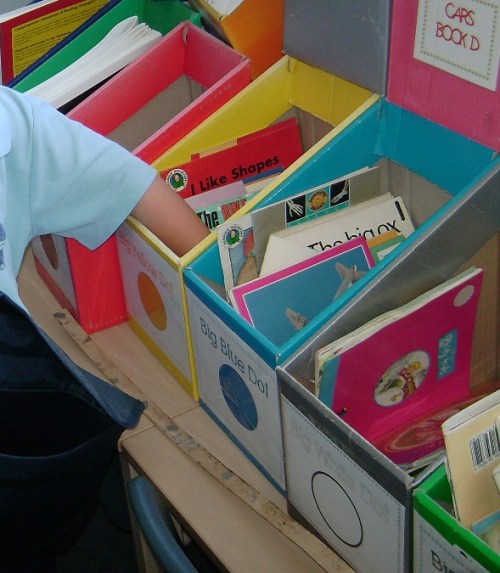
Home reading books are organised into Bands. For Example Big Yellow Dot contains books levelled RR 1&2 and so on… The bands correlate with the Victorian Early Year’s descriptors – Emergent, Early, Early Fluent, Fluent and Fluent – Extending. Each box contains a range of books – fiction and non-fiction. Even though the books in the boxes are levelled, some are shorter, some have more pictures, some are longer (this is what is meant by range). The books I have students take home, particularly at the beginning of the year are at an Easy level not instructional. Instructional is for Guided Reading sessions. I want the children to build confidence and fluency. I want reading to be enjoyable at home for the child and parent. Stress free reading at home is essential.


 My Strategy- Two Books Familiar & New

Familiar- This book is familiar and has been read by the student a number of times. This is the ‘warm up’ or ‘get your mouth ready’ book. This book can be read over and over. I find that when a child reads a familiar book first, they have more success on the new book. The ‘warm up’ book must be read independently and fluently.  The new book once read a number of times can become the ‘warm up’ book for another night. All I can say is it works!

When students start Guided Reading, I like to send their Guided Reading book home as well. It has to have been read a number of times and this is generally later in the year.


talk-photos-010


The information below is sent home to parents and explained at a Parent Information Night. I thought this might be useful.

 Reading At Home – Information for Parents


Reading with your child contributes to the development of positive relationships between parent and child. One of the greatest gifts we can give children is to read to them or listen to them read. The activity of listening to your child read, sharing the reading of a book or reading to them will remain with them all their lives.


Prep Home Reading Program


The time you choose to read with your child should suit your family and your child’s needs. The children are encouraged to select a book from the Book Boxes each day themselves. Your child will select a book to read independently to you from an allocated box. They may also choose books from other boxes as extras. Some classrooms may have a different process so please speak to your child’s teacher if you are unsure of how home reading works in your child’s room.


Your child’s reading log should be set up with the following

headings.


Date

Title

Comments

By

With

To

16/7

Trucks

Read well and used lots of expression.

 JD


17/7

My Dog

Our dog is just like this. We talked about the story.


 ND

18/7

Football

We each read a page and talked about the words.


JD


By: These are books read to you by your child. The children will know which box to select this book from. Each box is colour coded. This Book Box contains a range of books which are grouped together.


With: Some books will be too hard for your child to read alone or too long for them to comprehend. This is an opportunity to for you to share the reading of a book. If your child has chosen a longer book by reading ‘chunks’ yourself you will help retain understanding.


To: Reading aloud to your child will help them improve their literacy skills. Listening to an accomplished reader helps the listener understand vocabulary, patterns in language and the choices that writers make to engage their audience. In primary school many children stop being read to. Parents tend to believe that because most children at this age can read to themselves, they will not benefit from being read to. Nothing could be further from the truth.


Books chosen to be read by your child.


Pease do not focus on the level number of the book. The level number on each book is for the Reading Recovery teacher. The colour dots or ‘broad bands’ are for the classroom teacher and the books are for your child or you to read at home. 


Our emphasis as teachers is upon ‘reading for meaning’. A child may be able to read a very difficult text fluently but is unable to answer simple questions about what they have read. This is known as ‘barking at print’ and although the child may sound impressive, the point of reading has been missed. 

Emphasis should always be placed upon comprehension, not solely the ability to read aloud. The reading material your child brings home to be read by them independently should be easy for your child to read. This allows them to read fluently, use expression and comprehend what they are reading. Your child will be reading books of an instructional level within their classroom program. Some children enjoy a book so much that they borrow it regularly. Encourage your child to read their favourite book more than once if they want to.


Activities during the reading process.


Fiction Book


Before reading

Encourage your child to predict what the book might be about by discussing the title and illustrations.

Familiarise your child with the book by talking about the setting, characters and a brief discussion on what the book is about.

When talking about the book use the correct words (eg. Title, author, illustrator) and encourage your child to use them.


During reading

Ask your child to talk about what is happening in the pictures.

Pause occasionally and ask questions that will encourage your child to express a personal opinion (eg. What would you do?)


After reading.

Ask your child to retell the story in their own words.

Discuss the events that happened in the story in the order they occurred.

Discuss the personalities of the main characters.


Factual Books


Before reading

Find out what your child already knows about the topic.

Discuss questions your child is hoping the book will answer.

Ask your child to predict what kinds of information they think will be contained in the book.

Introduce unfamiliar words to your child.


During Reading

Ask your child to predict what information might be contained in the next section of the book. This develops an understanding of how    factual books are structured and how information can be organised.

Talk about information in visual or graphic form eg. Photographs and drawings.

Ask questions that can be answered by further reading.


After Reading

Ask your child to tell you what they have learnt from listening to the book or from reading the book.

Discuss new vocabulary introduced in the book.


Comprehension

Comprehension is the understanding process not product.


Conclusion

Please ensure that home reading is an enjoyable and positive experience for you and your child. Be patient and show enthusiasm when reading with your child. If you are experiencing any difficulties please speak to your child’s teacher. It is important to remember that all students can achieve success given sufficient time and support.


Hope you find this interesting.

Cheers Nina


Leave a comment

Filed under Uncategorized

New Posts Coming: A Home Reading Program that Works! & Guided Reading- Why? When? & How?

picture-0291

Upcoming Blogs:  I’ve been asked to share the following:

Home Reading – Introducing Home Reading in Junior Classrooms, My  Program & Communicating with parents! 

Guided Reading – A Strategy to accellerate reading and comprehension: When? How? & Why?

Cheers Nina

Leave a comment

Filed under Uncategorized

My Top 10 Teaching Resources for an Early Years Classroom-The Must ‘Haves’!

classroom-2009-017

 PM Big Books

I have no desire to advertise, but sometimes it may benefit others if I do write about a particular publication that supports and scaffolds student learning. For student’s reading from RR Levels 1-6, I prefer to use PM books. Why do I like PM’s for beginning readers? PM readers introduce new vocabulary slowly, high frequency words are embedded into each text and are built upon at each level. The pictures support the text and the levels themselves are accurate. The topics are child centred.

As mentioned in previous posts, my student’s don’t start Guided Reading until they are Instructional Level 3. Children need to know about books and how they work before starting Guided Reading. For very early readers, I use Language Experience books and Shared Reading. 


talk-photos-0063 

Large Sentence Strip Board

Absolute Must! The sentence strip board is essential to my program. This is a critical ‘must have’ for all junior classes, not just Prep. Our Language Experience class made take home books are built from the text displayed on our sentence strip board. Once the sentence strip board is filled and a take home book is made, the sentences are pasted on to a poster and displayed for future reading. Re-reading our sentence posters regularly greatly assists reading development.    

 Mini White Boards

 Mini white boards are fantastic! My students love using them because they can be wiped clean. Children often feel more comfortable ‘having a go’ at spelling unfamiliar words when it’s not ‘pencil on paper’, I can only assume this is because it’s not permanent. They find using white board markers exciting, ‘ah…’ to be five again!  The picture displays magnetic alphabet letters. These are great for making words, ‘breaking and chunking’ (future post). I have a set of eight mini boards, which I protect with my life. Well, not quite, but I do love them!

 classroom-2009-012


 classroom-2009-0101The Changing Dice

How do I describe this?It’s a large cube/dice which has a plastic slip on each face. I can insert words, letters, sentences, and vocabulary for writing, such as who?, what?, why? and where? ,numbers and signs. The uses are limitless. This is a fantastic teacher’s resource and a ‘must have’!


 Magnetic Words

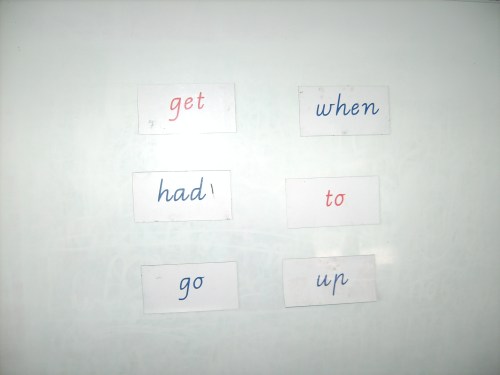
They come in a pack of 100 and include all basic sight words. When my students are introduced to a new word, I display it on the white board. It can be peeled off and ‘stuck’ into a written sentence on the board. The children can use them on their mini white boards as well. They can be written on with a white board marker e.g. what happens when we add a ‘magic e’ to a word? For example: Mat – mate

 classroom-2009-018


classroom-2009-015

Small PM Readers.

We’re all subject to budget constraints, but I believe having as many Guided Reading PM sets from Level 3 to 6 is essential for developing young readers. They are great for other levels, but just like any diet, we want to have variety and there are other excellent books on the market. Read Chall – Stages of Reading Develoment (excellent overview)


I Love Dr. Suess!

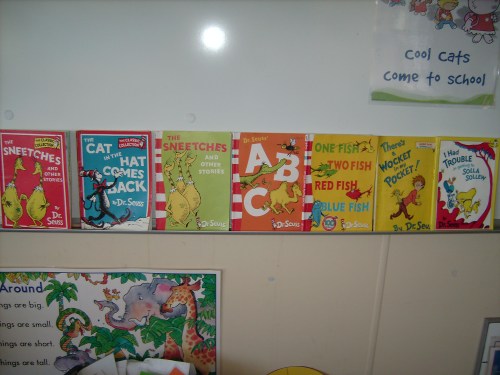
 I have a collection of Dr. Seuss books that I read ‘over and over’ again. These books are popular with my Preps (and all children) and often make their way into my student’s school bags at the end of the day. In the easier books the vocabulary is phonetic, rhyme is integral and simple sight words are repeated. Dr. Seuss books are also wonderful for the older readers. Check them out, if you haven’t already!   

  classroom-2009-0042

Teacher’s White Board

Let it roll! I love my roll around white board. It’s magnetic, can hold and display posters and can be rolled around. It’s just the right height for young children to use when they contribute and all children can see it clearly when sitting on the floor.

 classroom-2009-002


classroom-2009-008


Lego

I have lego and a large lego board. I use lego in my Numeracy and Literacy program as well as Developmental Play, for example they might build a story set and act out a story they have read. My kit includes little people, wheels, small boards, windows etc. Buy a kit which includes the extras.

 picture-0742

The Big Book Stand

I was very excited when I found an old rickety Big Book stand that nobody was using. With a clean and a blue Velcro board, it was ready to go! Having a Big Book stand allows me to have a Big Book area (previous post). It means that Big Books are on display and can be easily read by children. It’s about making teaching easier! Once again, it rolls, so I can move it out of the way easily if I need to.  

 Next Top 10 – Upcoming Post & Home Reading – My way!

I hope you’ve got plenty of money in the budget!

Cheers Nina


9 Comments

Filed under Uncategorized

Teachers are Hot in Australia! – Next Post: My Top 20 Resources for the Early Year’s Classroom.

Thank you for the e-mails and future post suggestions. My next post will itemise the ‘must haves’ in terms of resouces for an Early Year’s classroom. These are the resources that are I can’t teach without. So check your budgets!

Cheers Nina

P.S For anyone reading this blog from other areas of the globe. We officially started back this week after our summer holidays.

The temperature is a pleasant 44 degrees Celisius.

Thats 111.2 degrees Fahrenheit! 

Hot! Hot! Hot!


Leave a comment

Filed under Uncategorized

Let Them ‘Do’: Creative Children are Vibrant Individuals

I love to see vibrant classrooms displaying children’s artwork, whatever the age. With our ‘crowded curriculum’ and the pressure to teach the 3 R’s coupled with assessment, it is this vital part of our program which is often sacrificed.

Young children, in fact, all primary students need to create. Parents need to understand that creating art and craft works is an important part of learning, not just something done in the Art Room. Many of our student’s future careers will be in the ‘creative industry’. Displaying children’s artworks is a celebration of their creativity.


sea-visit-0401

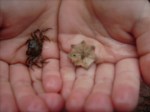
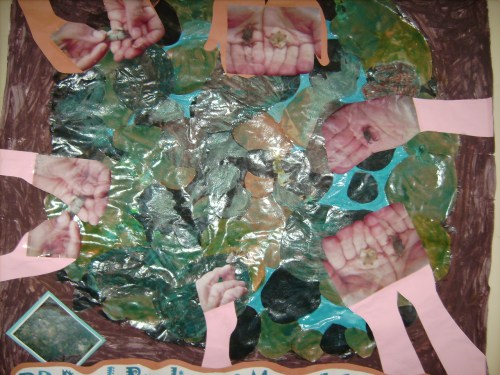
Inspiration  for our mural came from photos taken on our exploration of rock pools at Moondah Beach.  As part of our Inquiry into Sustainability -Living and Non Living, we had ‘hands on’ sensory based activities in the ‘real environment’.

sea-visit-0541sea-visit-056sea-visit-046


sea-visit-2-012


Murals allow children to contribute to a large piece of art work. Each student’s contribution is valued.


extra-photos-004

When planning my program e.g. a book response, I like to include  written, sensory, oral, artistic and dramatic activities. My desire is to develop the ‘whole child’ !

Cheers Nina

Leave a comment

Filed under Uncategorized

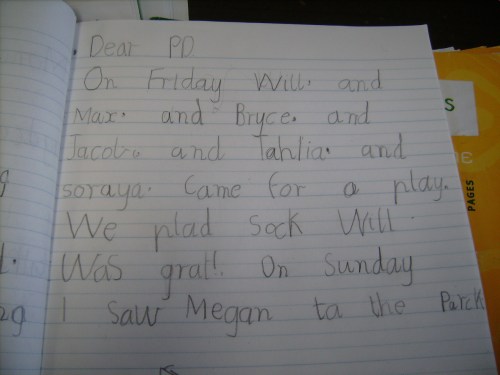
Yes, I’m 5 and I can write!


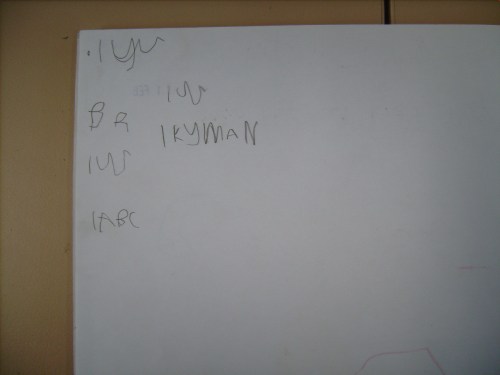
On the very first day of school, I ask my Prep children to write. It’s the start of their writing journey and I want them to have a record of where their journey began. Some will get started quickly and others will sit there wondering ‘what on earth’ she is asking me to do! This is when I start talking about what writing is and why we write.

picture-0132


 I encourage the children to write their name, any letters they know or just put ‘something’ on their paper. After they have put ‘pencil to paper’, I ask them what their writing says. If they look at me blankly, I get them to tell me what they would like their writing to say and scribe.

 picture-0162From day one, I start talking to the children about ‘taking risks’, ‘having a go’ and that we read writing, not just books. This is a concept that we think children understand, but they don’t always. I PRAISE any effort, show my excitement and celebrate all attempts made by my students every time they write. When a student makes a ‘learning leap’ we do a ‘happy dance’. Preps love to have fun and they don’t have any ‘hang-ups’ about dancing! I want my students to develop a positive attitude to writing which hopefully will be life long.


picture-0172


At the end of semester 1, we have Student Led Interviews, where the children talk to their parents about their learning growth. They show pieces of writing that they have selected that display their development. I’ve found that, with preparation Prep children are very good at explaining their learning growth. To encourage this type of thinking, it’s important to develop the skills of ‘reflecting upon their learning’. We reflect each week formally and everyday orally. When a parent asks, what did you do today? I want my children to be able to answer. This is not a natural skill for most children and therefore needs to be learnt.


picture-0531


Please read my previous posts:

Very Young Children Can Edit: Develop criteria, hand over the responsibility and watch them grow.

Literacy – Inquiry Learning – Writing with Purpose!

The power of Interactive Writing as a model to accelerate writing development 

 Cheers Nina


Leave a comment

Filed under Uncategorized

The answer to the most frequently asked question – Why blog? Authentic Learning!

Every time I talk to someone about my blog, I get the same question.  They ask me, why? It’s almost like there must be a hidden reason. They keep asking me where this will lead me, and my answer is, I don’t know. At the moment, I’m interested in the journey, not the destination.

I’m loving the challenge and I’ve been looking for one. I also know I want to keep learning and improving.

Just like children, I want my learning to be authentic. I want the purpose to be real and yes, I could read about this, but it’s the ‘doing’ that’s pushing my learning further than I could have imagined. I’m engaged in what I’m doing!

I also value my teaching and wish to share my teaching and learning strategies with others. I’m reflecting on my teaching, and I’m thinking about global linking, internationalism and how I can incorporate ICT into my program. Others are teaching me and that’s the amazing thing about Web 2.0. People are actually reading and responding to my blog! Teachers want to share!

I’ve been listening to Jenny Luca  for a year and following her journey into Web 2.0. It didn’t take long for Jenny to start speaking a language that I couldn’t understand, and talk about things I had no idea how to do. Her enthusiasm was contagious and her encouragement and support has been ‘what has got me this far’. Jenny taught herself everything, but I’ve been lucky to have a mentor.

Ten new ‘things’ I have learnt.

How to set up a blog.

How to manage a blog.

Uploading pictures.

Creating Links.

Creating tags.

Inserting a utube video into my blog.

Replying to comments.

What a meme is.

What a wiki is.

Other people who will teach me.

What I want to learn!

I want to ‘twirl on twitter’.

I want to connect with teachers around the globe.

How? I have no idea, but my problem solving strategies are different now. I now seek answers through Web 2.0 and I get them.

What I can do!

Teach others about what I have learnt and support their journey, share my classroom program, develop a professional learning plan for ICT and pursue my interest in global issues. It’s all about improving my teaching and therefore my students’ learning! 

Cheers Nina

 Enjoy the video! Lego Man Guided Reading (very clever)


7 Comments

Filed under Uncategorized