Category Archives: Uncategorized

The Writing Rich Classroom: I’m in my first year of school and I can write. Do you want to read it?

It’s the beginning of second term and I’m excited or should I say relieved! I’m whitnessing all my Prep’s writing confidence and ability leap forward. My ‘talk and write daily’ philosophy is working, combined with good Early Years practice i.e. Guided Writing, Interactive Writing, Modelled Writing, Shared Writing and Independent Writing.

I keep re-posting Interactive Writing because I truly believe it is a key strategy for early writers.

It’s wonderful to see Prep students (first year of formal education in Australia) work cooperatively in groups to produce a piece of writing within the first few weeks of school. They may not know all their sounds, but with an alphabet chart/pictures for reference and whatever prior knowledge they bring, writing skills are quickly developed and extended. This is a powerful teaching strategy.

Each child has their own colored texta and writes their name down the side of the sheet making it easy to see a child’s progress. Generally, I have groups of 4/5 students selected randomly. At the beginning of the year the sentence is provided after class discussion and is related to a shared experience e.g. I am at school. Teaching children to prompt each other without giving the answer is taught during Interactive Writing. Read my earlier posts!

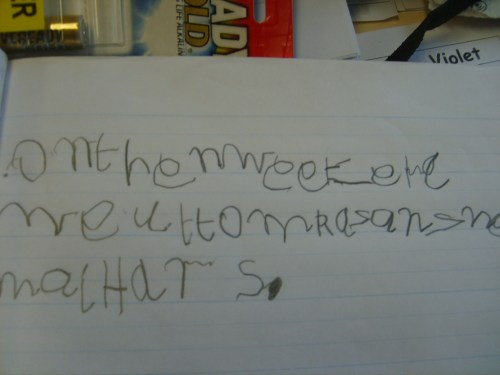
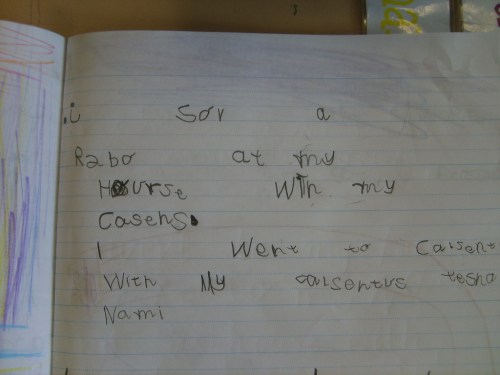
Below are some snapshots of my student’s writing taken randomly. The development and range in the grade can be seen, but they’re all on their way forward. This week we started what I call ‘real thinker’s writing’. This was a response to a text ‘ Water Bugs and Dragonflies’. I wanted to know if my preps (5 & 6 year olds)  could record their ideas. Journal / Recount writing becomes very comfortable for young children and can ‘stop’ them ‘moving on’ , if other writing opportunities aren’t given. Children can fall into the cycle of writing ‘ I went to the ….’ over and over. I was amazed by what my student’s wrote and will include photos in a future post. Here are some examples of their journal writing.

S5005756

S5005755

Sample 1: I stayed home. Sample 2: On the weekend I went to my cousin’s house. Sample 3: On the weekend I went to get some tyres.

S5005763

S5005766

One of my students brought their writing to me and challenged me to tell them what it said. I read it and they looked at me in wonder. The connection between writing and reading was made for this 5 year old. This student said, ‘you read it’ ( still with an amazed face). My response was, you asked me to!

Cheers Nina
2 Comments

Filed under Uncategorized

Web 2.0: Do you know what that is? Web 2.0 for ‘Newbies’

The KnowledgeBank Portal is coming. What does this mean for teachers? I’ve just finished reading about KnowledgeBank: Next Generation and about the KB:NG Project who’s role will be to deliver policy on the appropriate and effective use of Web 2.0 technologies.

That’s great, but there seems to be a missing step and that is educating teachers on what Web 2.0 actually is and how to use it- full stop! I’ve been educating myself on Web 2.0 applications (with the help of Jenny Luca as a mentor) and have found that many teachers simply don’t know what  Web 2.0 is, yet alone how to use it appropriately.

I’d be interested to hear if others disagree  or agree with me. Just like students, teachers need explicit instruction on Web 2.0, so they use the applications confidently and in a sustained manner. By this I mean not as a ‘one off’ , but as a planned part of the curriculum.  I’m trying to do all sorts of things, but am often let down by equipment or programs. I’m hoping that this will change for me in the future.

Found a great utube- Web 2.0 for Newbies

Leave a comment

Filed under Uncategorized

MORE Literacy Websites for Primary Students! Some great resources so check them out!

Here are some more great websites to explore and a number of these are for older students. Cheers Nina

Useful because…

www.poissonrouge.com

Fantastic site for students with little to no English. Easy to navigate, relies on visual prompts rather than written instructions. Contains hundreds of activities; mainly fine motor skills, creativity/self expression, plus some literacy/numeracy/thinking.

http://www.learningplanet.com/stu/kids0.asp

Simple literacy & numeracy activities, categorised into primary grade levels. Requires some English to understand instructions.

www.literacycenter.net/lessonview_en.htm

Contains interactive numeracy/literacy-building activities on topics such as alphabet, numbers, shapes & keyboard skills. Nice big, colourful text & easy to navigate.

www.sproutonline.com/sprout/games/

Bright & colourful site with cute games for building skills in literacy, numeracy, thinking, problem solving, fine motor skills, memory & creativity.

www.juliasrainbowcorner.com/html/funandgames.html

Highly visual site containing literacy/numeracy building activities. Can be navigated with little to no English.

http://www.bigcomfycouch.us

=Very simple site with LARGE text & images, covering very basic concepts, eg. alphabet, numbers, colour & shape. Limited selection, but easy to understand & use. Also has flash stories, sing-a-longs & a section for parents.

www.abc.net.au/children/

Games, stories, activites etc. with (possibly) recognisable characters, eg the Wiggles, Bananas in Pyjamas etc. Students can choose activities by theme or character.

http://www.paulysplayhouse.com

Contains games & lab activities to develop motor skills & reinforce basic concepts, eg. number, shape, colour, letter & sound recognition. Bright & colourful, heaps to choose from but some English needed to navigate.

http://www.britishcouncil.org/kids

Includes games, songs, stories & writing activities. Games are theme based, from basic (numbers, alphabet) to more advanced (environment, ancient Egypt etc) Some English needed to navigate site & follow instructions.

www.manythings.org

Includes sections for grammar, spelling, pronunciation, listening etc. Also lots of games, games,puzzles, activities etc. students can do on their own. Students need some literacy & independent working skills to navigate site & read instructions


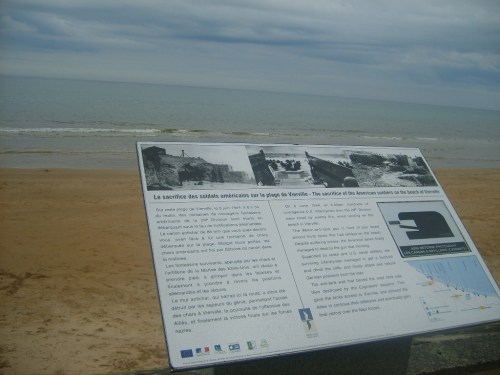
More France photos: Normandy- I hope they’re not boring you!s5005663 Omaha Beach  Follow link for a soldier’s story.

Leave a comment

Filed under Uncategorized

Great Literacy Websites for English as a Second Language Students & all children!

Every now and again someone sends me something really worthwhile. The following is an example of this.

 10 useful websites for teachers of ESL students & all Litearcy Learners

 Website

Useful because…

http://www.teachers.ash.org.au/jeather/writingfun/ writingfun.html

Great for writing genres & text organisers, can be used with smartboard & has printable pages. Best for upper primary.

http://www.sparklebox.co.uk/

Clear & simple layout, thematic units, good for very basic literacy & numeracy resources. For lower primary & brand new arrivals.

www.abcteach.com

Varied materials ranging from simple alphabet exercises & flashcards to more advanced activities. Categorised into subject areas & themes, includes fun activities like puzzles, word searches, word scrambles & colouring pages. Appropriate from lower to upper primary.

http://www.mes-english.com/

HEAPS of free flashcards, worksheets and accompanying handouts, phonics cards, games, printable certificates, stickers & other activities. Also has some flash games that go with printable materials, to reinforce vocab etc. Middle to upper primary.

http://www.busyteacherscafe.com/printables.htm

The name says it all. Not specifically for ESL students, but worksheets are clear & attractive with large text & space to write. No much vocab building/thematic stuff, but good for thinking, organisation, writing development etc. Best for middle/upper primary.

www.edhelper.com

Similar to abcteach.com. Also has puzzle maker feature & activities for critical thinking & problem solving. Best for upper primary. Some sections require membership to print materials, but some are free.

http://www.esltower.com/teachers.html

Scroll down just a little to find a huge selection of printable worksheets & exercises related to vocabulary building, grammar, parts of speech etc. You can also search the site for any topics/themes. Results will appear on the right side of screen, and links to other websites on the left. A lot to look through, but very comprehensive materials. Includes video lessons for pronunciation etc. Best for upper primary/extension work.

http://www.english-4kids.com/

Similar to website above, also with PowerPoint lessons & videos.

www.usingenglish.com

Includes hundreds of printable resources for ESL students. Best for upper primary; lots of written activities- grammar, spelling, punctuation, vocab etc. Useful if you’re looking for very specific exercises for more advanced learners, eg. verb tenses, parts of speech etc.

http://www.coloringcastle.com/

Just colouring sheets. Organised into themes down the right hand side of screen. Includes alphabet & numbers, so can be useful for pre-literate students, to start discussion about various topics, or just for fun. Some great mandalas & geometric shapes for students with more advanced fine motor skills.

 Source: Noble Park English Language School

s50054742

Photo: Shakespeare and Company – The famous English bookstore in Paris frequented by Earnest Hemingway and F.Scott Fitzgerald.

Cheers Nina


Leave a comment

Filed under Uncategorized

Viva La France – EaB International: The Victor Hugo School Paris

Bonjour,


Well, oui I’ve been to France! On the first Monday of the Australian (Victorian) school holidays my fifteen year old son and I jetted off to Paris to stay with my brother, sister in law and nine year old nephew who have been living in Paris for nearly a year, for two weeks.

On arrival at Charles de Gaulle Airport, after a couple of lengthy flights including managing our transfer through Hong Kong Airport (an experience) we slid into a taxi and headed to Mirabeau in the 16th Arrondissement (District). For Victorian readers the 16th District is the Toorak of Paris – beautiful  (my brother is obviously not a teacher!).

Nina's Picks 112 - Copy


We walked through the door at 9 am, put down our bags and headed out to the local coffee shop. Sitting outside, I enjoyed my first coffee experience (one of numerous for me as I quickly learnt that a coffee meant toilets!) in amazing surroundings. The day was planned by our Parisian family as a ploy to help us through our jetlag. 


A visit to the EaB International: The Victor Hugo School – Paris

The Victor Hugo School has been an IB World School  since March 2003.

We arrived the day of my nephew’s school open afternoon and my son and I were invited – permission granted. This is a big event, as parents have to make appointments to enter the school and rarely see their child’s classroom. This is also something expats grapple with, after coming from Australia where parents are used to an ‘open door’ policy, but security is high in international schools.

My nephew attends the EaB International: Victor Hugo School. When visiting any school I’m always on the lookout for ideas – not just to compare! I was not disappointed. The differences were obvious. Space is at a premium in Paris so classrooms are very small. My nephew’s classroom is small by Australian standards, however, there were approximately 14 students in his grade so that’s the trade off. The French students attend school for 30 weeks a year and there are 5 public holidays in May and others during the year. They have a half day on Wednesday where students can go home or do sport. My nephew is doing tennis as an optional paid extra – sensible Aussie parents.

His teacher was welcoming, but also overwhelmed as there really wasn’t enough room for visitors in the classroom. The activities the students completed with their teacher while I was there, were the same activities that I have presented to children in Australia -literacy activities and numeracy games. I observed students who were engaged and enjoyed sharing their writing orally with all visitors.

The children were then taken to their Violin class which was taught in French (which my nephew seemed to understand) but I didn’t. Then it was off to French language class where the children sang songs for us. Visiting a school in another country is a terrific experience. There are obvious differences but also many similarities.


Nina's Picks 062 - Copy

 Photo- Writing displayed at the school. Impressive!

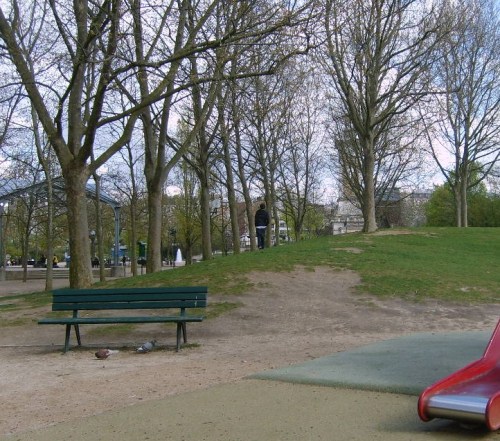
After school we went to the park that the school uses at lunchtime as there isn’t a playground. The park is breathtaking! These children are not missing out. My nephew’s friends and their parents meet each day after school so that the children can play outside (most live in apartments).

Nina's Picks 083

My nephew has made many friends at school from different countries around the world. He is by nature a very social ‘Aussie’ boy who would adapt easily to any environment and that’s my observations as a teacher. He’s not too keen on homework which seems to be plentiful and likes spending time with his mates playing and of course the computer which he uses with ease. He told me how he narrates cartoons and uploads them to utube and they’re good – yes, he is only nine! His education for the last year has certainly not been confined to the school. Paris and beyond has been his classroom.

 S5005689


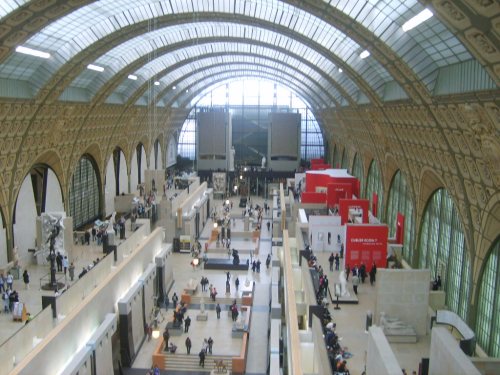
My favourite musee even more than the Louvre: Musee D’ Orsay  


As I write this post my nephew and his parents will be part of an Australian group attending ANZAC day at Villers Bretonneux. Another example of learning through ‘real life’ experiences.


Au revoir


Nina


Next post: Guided Reading – Forming groups

4000 hits and going strong!

9 Comments

Filed under Uncategorized

3000 plus hits and still going! What is the big change in education?

Over 3000 hits!   Thanks for reading and responding!

Today I had a university student studying to be a teacher visit me to discuss what the big change in education is ( my opinion)! Big question for an assignment, but my answer was immediate, it’s technology and how we as teachers will know and use what is available to improve student learning and engagement in our rapidly changing world.

We looked at Lucacept, CONNECT, the 2009 Horizon Report and Working Together 2 Make A Difference. Amazed! 

I’m not quite as excited as the fellow in the video, but it did make me laugh!Cheers Nina

Leave a comment

Filed under Uncategorized

Are you connected? I am! DEECD CONNECT

This morning Jenny Luca suggested I look at DEECD CONNECT to look at Web 2.0 applications. Well, what a fantastic website it is. Loads of resources, explanations and ‘how to…s’) and just what I need! For Example: The SLAV Connect provides a link to Bubbl.us, an online brainstorming tool-I’m already thinking of the ways I can use this tool. There are teacher resources, for example, how to create a wiki with links and great examples of created wikis. Check out the Prep Mansfield wiki. This has got me thinking! Too much to explain everything connected to this site, but my advice is visit and connect.

Excerpt – DEECD CONNECT

‘Teaching and learning are changing. Web 2.0 applications such as blogs, wikis, podcasting and other tools can give students the opportunity to communicate, collaborate and share their learning in an online environment with an ease never before possible. There is enormous potential for education. How will you respond? 

It is not just about increased use of technology but HOW the technologies are used … an idea illustrated in the video Shake it Up, based on Karl Fisch’s original presentation.’ Follow links and watch – if you haven’t got time, make time!

and

‘As we increasingly move toward an environment of instant and infinite information, it becomes less important for students to know, memorize, or recall information, and more important for them to be able to find, sort, analyse, share, discuss, critique, and create information. They need to move from being simply knowledgeable to being knowledge-able.’

From Knowledgeable to Knowledge-able: Learning in New Media Environments, Posted January 7th, 2009 by Michael Wesch

I’ve had some e-mails asking about how I make Guided Reading groups. I’m still working on this post but it will be up soon.

Cheers Nina 

Leave a comment

Filed under Uncategorized

Global Students, International Mindedness, What the ‘ning’ is that?

Today reaffirmed why I love teaching and why this generation of children are special.

My preps (1st year of school in Australia- 5 year olds) joined a year 5/6 grade (11-12 year old students) to look at the ‘ning’, Working Together 2 Make A Difference. They are now familiar with ‘nings’ and their relationships with older students is developing. I must also say it was a pleasure to watch these older students pair up with a younger student and help them to understand. They’re already making a difference! We are a learning community.

Why are we involved? Last year Jenny Luca sent information to me about a ‘ning’, Working Together 2 Make A Difference and I sent the link to my colleagues. At that stage, I didn’t even know what a ‘ning’ was! This year, I started becoming active in the ‘ning’ and to my surprise I found another staff member from my school had joined. We didn’t really get to know each other last year, different areas of the school and teaching very different year levels. Well, now we’ve connected through the ‘ning’ and are collaborating on a joint project.  

We’re supporting the Daraja Academy, which is a new school in Kenya for girls who wouldn’t have secondary education without this school. We showed the ‘ning’ and explained what it was about to our students. Africa was introduced through the ‘real life’ experience of my colleague growing up in and going to school in Africa. Her treasures were shown and explained to the children. The students were silent and totally engaged! Then we showed a video about the school. You could have heard a pin drop.

Back in our classroom my students talked about their discoveries. As part of our Inquiry we have been inquiring into, what is a school? , what is a class? what is the same and different about students in our class? and how does a school work? This project is about taking their thinking about these questions further and developing their sense of being a ‘global student’.


Their discoveries are listed below as said by my students: They may be 5 years old but they connected and ‘got it’!


Discoveries

-care for people

-our school and the Africa school, not the same

-different schools

-different people

-talk differently

-nice people from a different country

-different chairs- we have chairs and they have stools

-some houses are made of wood and some are made of brick

-mud bricks

-we all live in different countries

-beds-they live at school like Madeleine

-wasn’t much trees –not like here

-not a lot of money

-our buildings are nicer-African school didn’t have carpet-it has concrete

-no play area

-speak differently

-different colour skin

-no cars

-different hair and eyes

-be nice to people

-different food

-we’re all different but go to school

-schools look different in the world


Our next step is to Skype- conference, Mark Lukach a teacher in America involved in this project into our classroom to talk to our students about the school and their needs. Once the children know the needs of the Daraja Academy we can brainstorm ideas about how we can show support. It will be up to our students to decide how we help, as this project is teacher introduced but student driven. One thing I know for sure is our students want to make a difference!

Please watch the video below and visit Working Together 2 Make A Difference.


Cheers Nina

4 Comments

Filed under Uncategorized

Professional Development – not shameless self promotion.

I’ve spoken to Jenny Luca and asked if I can take part of her post on Professional Development – not shameless self promotion and add to it. I’ve written several posts on ‘why I blog?’, as it seems to be a hot question. The reactions of colleagues are varied, some very positive and others, well…!

I have received an enormous amount of professional development this year, self generated and cost free.  How I explain this to the VIT is another question but what has made this possible, is a mentor, a colleague (from another school) who is happy to take me on and develop me professionally with commitment and patience.  Mentoring, coaching, sharing, whatever you want to call it, is a powerful way to develop us all professionally. My blog is about professional sharing! It’s also an authentic way for me to apply my new skills.

Web 2 and ICT applications  is new territory for me, but having read the 2009 Horizon Report K-12 Edition, I know that I’m equipping myself for classroom teaching changes during the next five years.

Excerpt:  Jenny Luca & link to full post.

‘Are you like me? Is your head swimming with everything that is now possible in our world as a result of the Web and the ease of transfer of information? We are so connected in today’s world. I can get onto Twitter and make connections with educators around the world and share ideas – I can find out what’s new and add my two cents worth to the conversations taking place. I read feeds coming to me in my Google Reader and am in awe of educators who are willing to share their knowledge to empower others. I am thankful to software developers who are willing to provide open source products that are making our lives easier to manage and our classrooms more interesting. I feel like I am in a constant state of professional development and what has it cost me? Time and an internet connection. What has it cost my school? Nothing this year – I haven’t been to one PD session and yet I feel like my knowledge attainment has been exponential.  How will this benefit my school? Plenty. I have knowledge and am willing and eager to find ways to share it – writing this blog is one of vehicles I am using (just hope some are reading!). 

I’ve been mulling this around the last 24hrs after reading Liz Davis’ post where she reflected on how she wondered if alerting people to her blog posts via twitter was an act of shameless self promotion. The post resonated with me because I’ve shared these thoughts – is what I’m doing a way of grandstanding? Look at what I know- nah nah na nah na! I’ve talked it over with friends who aren’t a part of this network and they tell me they are learning from what I am writing so I feel like what I’m offering is worthwhile and not self serving. I think people who are blogging about educational technology should be giving themselves a bit of a pat on the back – what I’m finding from my reading and conversations is on mass Professional Development for free!’

Thanks Jenny for being an inspiring educator. We’ve had many conversations about knowledge hoarders and sharers. VIT World Teacher 2008 you certainly are!

Cheers Nina

1 Comment

Filed under Uncategorized

Maths- It’s Cool! Representing numbers 5-10.

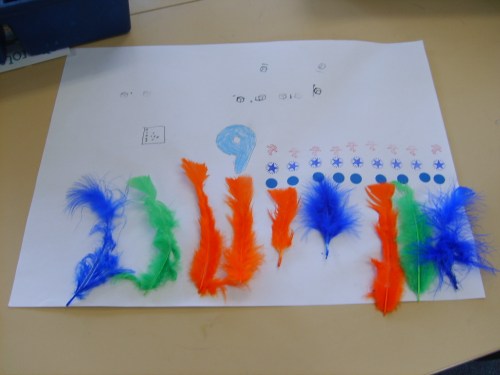
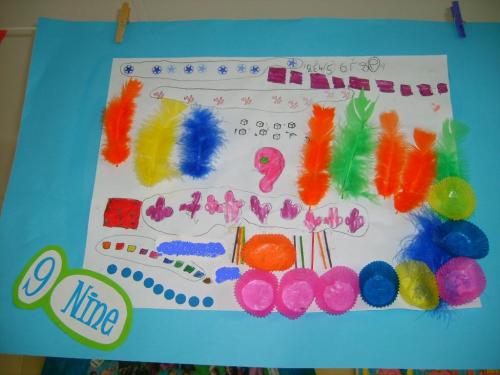
Just a quick post! My students had a great time today displaying what they know about numbers 5 to 10. They worked in pairs, were given a number and used an assortment of items to represent their number. They could use stickers, various stamps, feathers, draw various counters, trace and write their number. The photos below clearly show their understanding. It was an industrious session.

s5005261

  s5005279   

 s50052811

 Cheers Nina

Leave a comment

Filed under Uncategorized