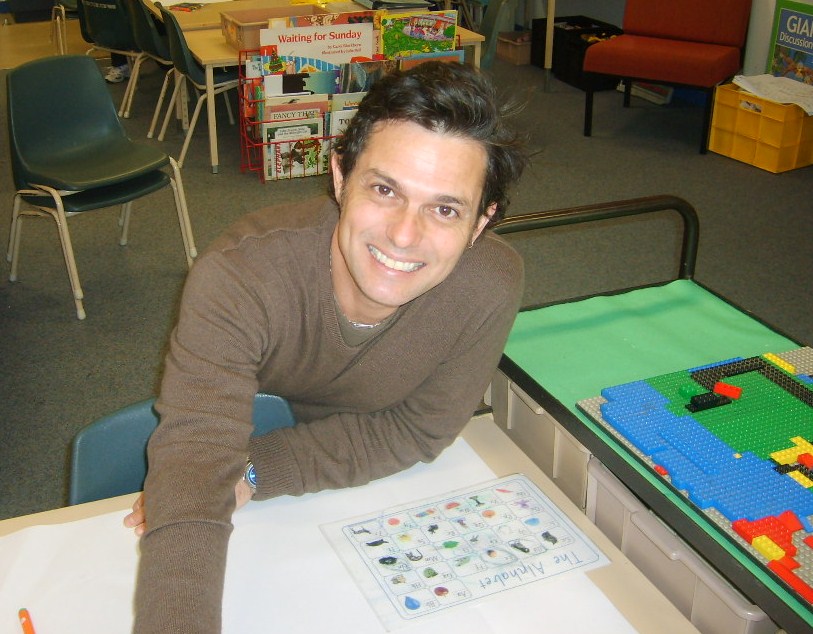
Thank you Ash for all your wonderful work in PD. Your art background has provided the children with many opportunities to express their innate creativity. Your contribution to our Toy Story inquiry has been superb so don’t forget to visit, and hopefully we’ll see you again this Friday. You really are great with a glue gun!
Thank you Max for all your work in Team PD. The children have loved having you work with them! This last week certainly displayed that you are going to be a wonderful asset to this profession. Thank you for all your planning while I was away and don’t forget to visit! Next time we need a professional photographer, not a child… and an iphone!
This year I’ve been part of the Southern Metropolitan Region Community Engagement Project. As a participant of this project I have been looking at different ways of engaging our school community. I’ve outlined the project I developed for my school below. It’s been a ‘new way’ of engaging our parents in how theirchildren learn and our curriculum. My project is outlined below.
I would love to know if other schools are providing interactive workshops for their school community. Please let me know what you’ve been doing in your school to engage your community.
Letter to school community:
You are invited to be a part of the:
Community Engagement Project: Assisting in the Classroom Program
We are offering three interactive, fun and engaging sessions targeting helping in the classroom. These sessions will highlight the ways you as a parent can contribute and gain from adding to the learning experiences of all children you assist. Assisting in the classroom can have an enormous impact on learning gains for students. These sessions will incorporate time for questioning, reflection and maybe even a little bit of homework. Come a long; bring your ideas, hopes and fears.
We will be filming part of these sessions so please let us know if you would rather not be filmed. If you are willing to be part of a short filmed interview at the beginning of the program, and at the end please let us know. We may even approach you!
Session Outline & Dates
Session 1: Assisting in the classroom: Engaging Learners. How can we encourage children to ‘have go’, and ‘take risks’?Prompts we can use to extend thinking and help children in all curriculum areas. Fostering independence and inquiry!
Session 2: The Power of Questioning – The Questioning Toolkit There are many different types of questions e.g. probing, sorting and sifting, strategic, elaborating, clarification just to name a few. Come along and enjoy some role play! Understanding and using different types of questioning will be useful at home and in the classroom.
Session 3: Parent Forum – Answering your questions! This session will remain open and target the areas this group would like more information on. Questions will be collected and specific topics will be targeted. Your input will be vital.
In addition this is a great opportunity to meet other parents and enjoy discussing educational issues and concerns.
The third session of the project was completed this week, and the feedback we are receiving has been very positive. I’ve included a letter written by a parent who completed the three sessions below:
When I first heard about the “Community Engagement – Assisting in the Classroom” project, I thought, “this is for me”! My son is only in grade 1 and already I am struggling with the best way to help and engage him, as well as extract information from him… It is great to know, through attending these sessions, that I am not the only parent who feels this way!!
Lesson 1 was all about EMPOWERING, encouraging children to “have a go” and “take risks” both at home and in the classroom. The most significant thing I learned was how much EXTERNAL PEOPLE play a role in influencing, empowering and or crushing our spirit and growth. It was so thought provoking that as adults we still have very vivid memories of those who helped us and or hindered us along the way. For me it was a real eye opener about how much my child’s development was “in my hands”. The LEARNING ENVIRONMENT I create for him at home by being patient and constructively positive, will determine in the long term whether he thinks of me as someone who has encouraged and empowered him, or stifled his growth. That’s some responsibility!
Lesson 2 was about tools and questioning techniques. Did you know that it is not only OK to ask questions in class (even the parent dreaded question “why?”), but our children are actually encouraged to do so?? And there are no “absolute” right or wrong answers! I must confess that as a person who was in primary school 20+ years ago I struggle with this… This whole “inquiry” thing is very new and foreign to me. In my day, when we asked a
question in class we were either “right” or “wrong”, and as another mother pointed out, after you were “wrong” enough times, you became more and more hesitant to contribute. These days there seems to be a lot more grey, children are being taught to think broadly and be adventurous with their answers… If you have experienced a totally different way of learning, this modern learning style may take some getting used to, which is why understanding “how” my child is learning will help me, I hope! We learned some different ways of questioning, to get to the heart of a situation, or to extract information from our kids, which according to most in attendance feels sometimes like pulling teeth. Some really great ideas and techniques were shared through group discussion.
Not to skip over the “hard” questions that inevitably arise, there was quite a bit of focus on “how much is too much” positive reinforcement/ hand holding… We all want our children to grow up strong, independent and confident. And we want them to be responsible for themselves. Can this happen with constant “fluffy” positive reinforcement? What happens when one day we are not there by their side to give them the cheer on they have gotten so used to? We questioned, should we always be overtly positive when there is a big bad world out there that isn’t always so kind and gentle. Is the old fashioned “why”; “because I’m your mother and I said so” really so wrong? If we don’t explain “everything” are we stifling their “inquiring mind”? Who has the time to explain “everything”?
Because of this line of questioning, our third lesson was dedicated to effective ways of giving feedback. What kind of feedback is good for our kids and what is “wasted” or even “harmful” to them. We learned feedback is not at its most effective when it is that fluffy positive reinforcement, always telling your child they are “awesome””fabulous” “fantastic” at everything, but is more effective when we focus it on the “parts of their work” that is good, that they did well. Our kids know what “good” looks like. Lets help them aim for that by acknowledging the “good” and by also giving them direction as to where they could improve by highlighting other parts of their work they could do “better”. We also talked about encouraging our children to self-assess, which sounds like an amazingly simple tool, which I confess to never having used! Using questions like: How do YOU think you did? Which part is your best work? Where do you think you could have done better? We talked about not simply focusing on how well a task is performed but in the “learning intention” – did they get the purposes or intentions of the activity? Do they know what they were supposed to have achieved? Did they achieve it?
Last but certainly by no means least, we covered the concept of “fixed” and “growth” mindsets… As adults a lot of us really do believe “you’ve either got it or you don’t”. We put people in boxes: He is sporty, She is intelligent. In my family I am the “go to person for English” but dad is the one with the “maths” head. I have even said to my six year old “ask dad, mum ISN’T GOOD AT THAT”… (Anyone else guilty???) Is that the truth? Are we good at” or “bad at” certain things or did I just choose not to devote a lot of effort to a certain subject, extracurricular activity? Or going back to the effect of those “external influencers” did someone tell me I was not good at something so I just believed them and gave up? Did someone laugh at or make fun of me and therefore I decided I wasn’t “good at” something? Our children soak up the language we use at home like a sponge… Am I creating a positive learning environment if I say to my son it is ok for you not to be good at sport because I wasn’t. Am I encouraging him to put in the effort to build his skills? Instead, shouldn’t we be teaching that to be good at anything requires effort!! To quote Janet, “We all have our strengths, things that come easily and naturally to us. Then we have the things which are a bit harder and require more effort. We are not “bad” at them, they are not “weaknesses” but things we can do better with a bit of practice.” The more effort you put in the better you get, the old analogy that “practice does indeed make perfect”. We all have a starting point or “base” in everything we do. It doesn’t have to be where we stay, that’s our choice. Rather we should think of it, for ourselves and our children as a starting point or platform from which to build and grow.
In closing, on behalf of all the mothers and fathers who attended the workshops I would like to thank Nina and Janet for “engaging” with us. I feel I can safely speak for everyone who attended when I say, it was great! We can’t wait for the next one!
Kara
The following video was shown at the start of the feedback session and I have to thank Mark Walker for introducing the concept of ‘mind sets’. I also attained this video from Mark’s blog. You might like to read Mark’s post: Do you have a fixed or fluid mindset?
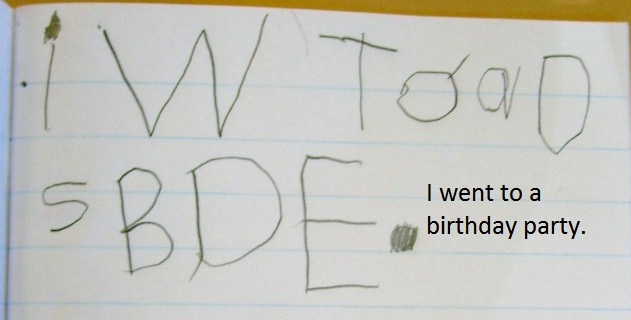
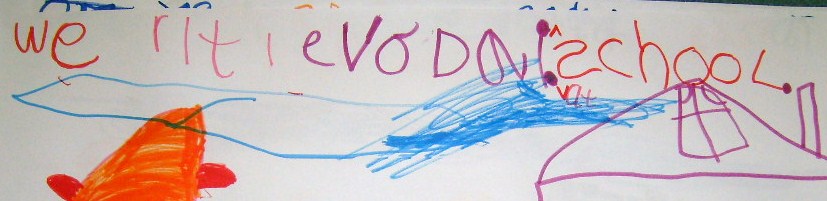
Life has been busy in Prep D. This group of students are wonderful young people, and I’m very pleased with their progress, use of strategies and ‘have a go’ attitude to all they do! I’ll be adding more to this post over the next few days, however, until I do take a look at the developing structure of a recountdisplayed in these samples e.g tiltle and sequence of events. Some children are even adding a personal comment.
Max and Ash from Monash University have been completing their teaching experience in PD. Today they did a wonderful PrepD Student Led Interactive Writing session. They followed the lesson plan consisting of shared teacher – student writing with an emphasis on strategies. The groups were allocated well ensuring success. The students were engaged and collaborated wonderfully. Amazing for this stage of the year. This post is to recognise their effort and success. It was great to sit back and see this teaching strategy in action.
The brainstormed sentence for today was: We always sit still and listen.
Having been contacted by Sara Wilson, Outreach Coordinator for the Non Profit organisation The Fresh Air Fund for Children, I’ve decided to support this cause by sharing their information in my blog. Before using my blog to support any organisation, I read their material thoroughly and check out reviews etc. I have decided on this occasion I will support this organisation by sharing their mission and providing a link to their site. How or whether you decide to support this organisation is up to you as the reader.
Background Information:
THE FRESH AIR FUND, an independent, not-for-profit agency, has provided free summer vacations to more than 1.7 million New York City children from low-income communities since 1877. Nearly 10,000 New York City children enjoy free Fresh Air Fund programs annually. In 2010, close to 5,000 children visited volunteer host families in suburbs and small town communities across 13 states from Virginia to Maine and Canada. 3,000 children also attended five Fresh Air camps on a 2,300-acre site in Fishkill, New York. The Fund’s year-round camping program serves an additional 2,000 young people each year.
Fresh Air children are boys and girls, six to 18 years old, who live in New York City. Children on first-time visits are six to 12 years old and stay for either one or two weeks. Youngsters who are re-invited by the same family may continue with The Fund through age 18, and many enjoy longer
summertime visits, year after year. A visit to the home of a warm and loving volunteer host family can make all the difference in the world to an inner-city child. All it takes to create lifelong memories is laughing in the sunshine and making new friends.
The majority of Fresh Air children are from low-income communities. These are often families without the resources to send their children on summer vacations. Most inner-city youngsters grow up in towering apartment buildings without large, open, outdoor play spaces. Concrete playgrounds cannot replace the freedom of running barefoot through the grass or riding bikes down country lanes.
Fresh Air children are registered by more than 90 participating social service and community organizations located in disadvantaged neighborhoods in the five boroughs of New York City. These community-based agencies are in close contact with children in need of summer experiences in rural and suburban areas. Each agency is responsible for registering children for the program.
A number of students are now extending their writing to three sentences which is wonderful for this early in our school year. To scaffold their learning I’ll be introducing the PM Recount Exemplars. At this stage I have started using time words and event sequencing in my modelled writing. I addition to this, I have been modelling a simple personal comment at the end of my recount. Many children have started writing a personal comment within their text as a natural response to my modelling. Next week I will be regularly using the PM Level 1 Big Book Recount Writing Exemplar to front-load my student’s learning. We will also commence building our ‘time’ vocabulary word wall. At this stage of the year I am focussing on; 1. Sequence of events: What happened? and 2. Personal Comment.
Title
Orientation: When? Who? Where?
Sequence of events: What happened?
Personal Comment
What makes PrepD Student Led Interactive Writing powerful? A little more information…
The key is that students are working collaboratively, sharing their learning, prompting each other and using skills and language generally used solely by teachers. Each student is engaged in the activity with each student committed to contributing with the support of their peers if needed. Groups can be structured to support children or to extend groups of children. The teacher can run a teacher led group at the same time,
which I do regularly once the children are skilled in the process.
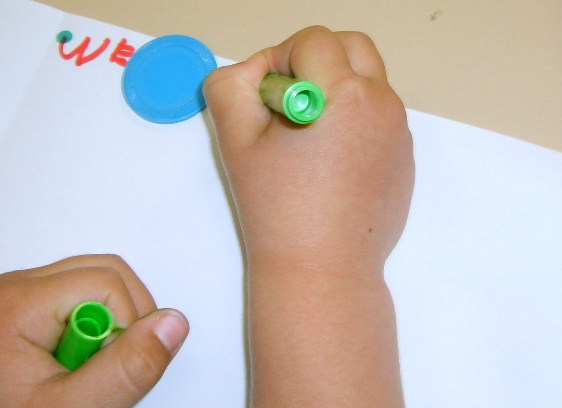
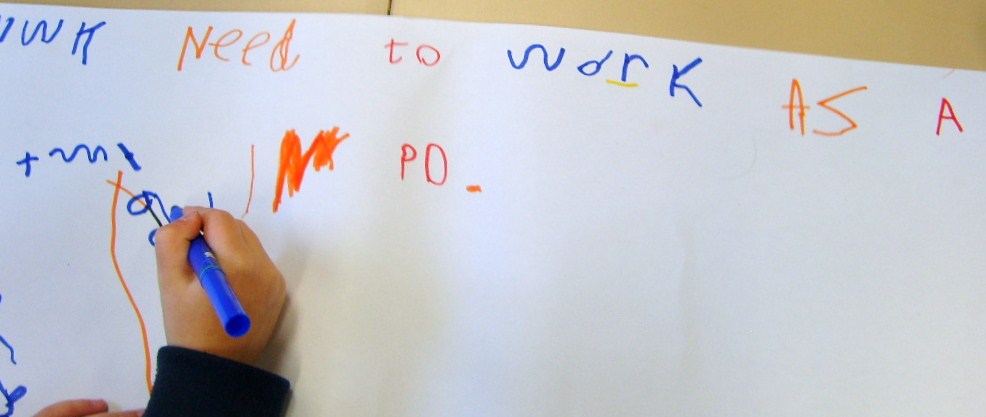
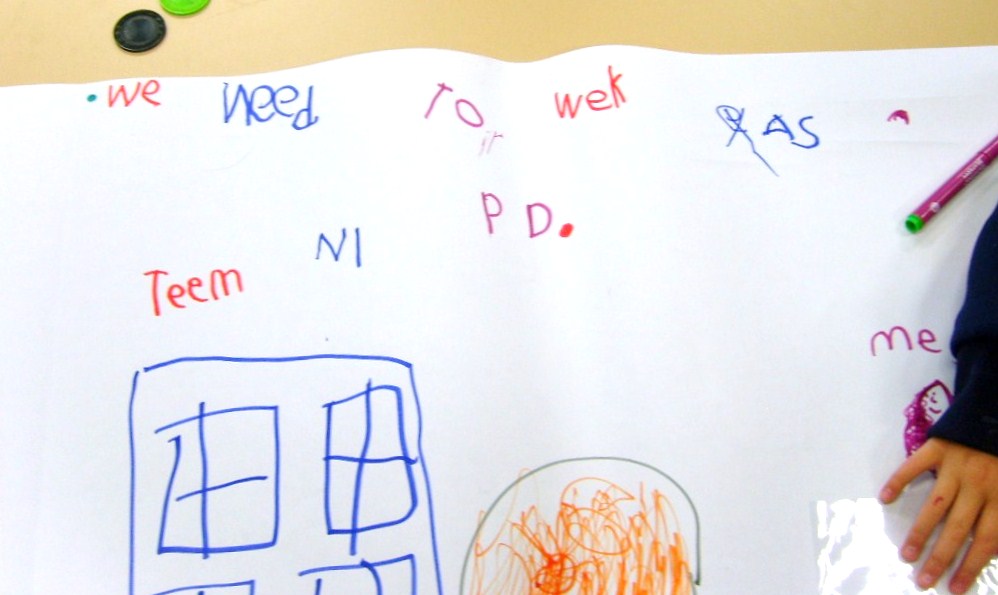
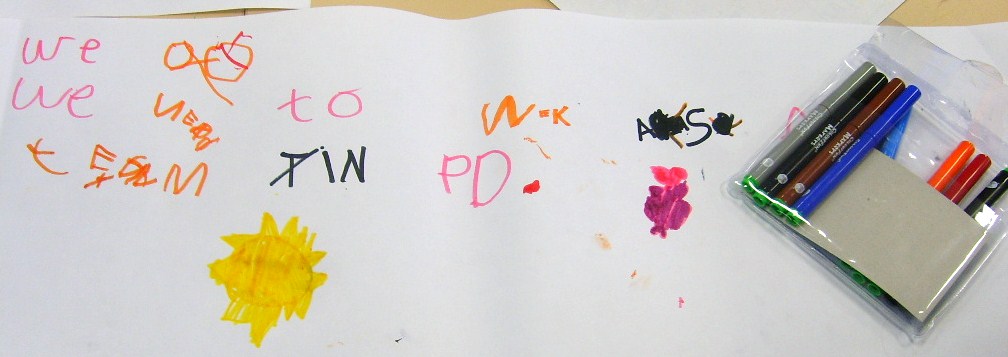
Each child is identified by a color and all are given the opportunity to lead a group. Teaching leadership skills concurrently is essential. The children are given poster sized sheets to write on and texta pens. I use Student Led Interactive Writing to assess and plan my weekly writing foci. It’s interesting to note that my student’s independent writing improves rapidly. I’m constantly looking for the transfer of my teaching into my student’s independent and Interactive Writing. Modelled Writing, Guided Writing and Shared Writing are also planned into my weekly program from week one of the school year.
At this stage of the year our sentence is based on the Language Experience philosophy.
‘What I can think about, I can talk about.
What I can say, I can write.
What I can write, I can read.
I can read what I can write and what other people can write for me to read.’
By the middle of the year my students are able to identify their learning needs and will suggest the foci for writing sessions. When this happens, I know my students are really moving forward on their learning journey. Some children, and they are 5 or 6 years old, will teach the writing focus or make suggestions for me to use. I love it when this happens! Groups share their writing with the class, and little books are made using their Interactive Writing texts for reading activities. This strategy extends highly able students, develops students working at the standard expected and supports less able students. I believe it accelerates the writing ability of all students.
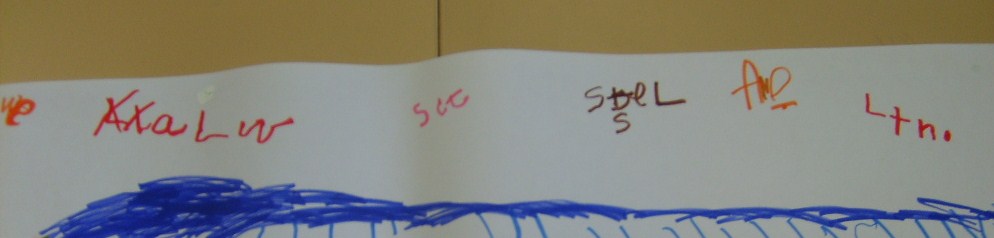
Our Language Experience sentence for week two: We need to work as a team in PD. It’s interesting to note that my students are now using lower case letters with increasing confidence. When looking closely at the examples below, focus on how each child spelt need, team and work. In our share session we looked closely at ‘ee’ and ‘ea’ as in need and feed, team and mean. Very tricky!
It’s timely to remind myself that these students are only in their 12th week of formal education in Victoria, Australia. Their writing and reading is amazing me!
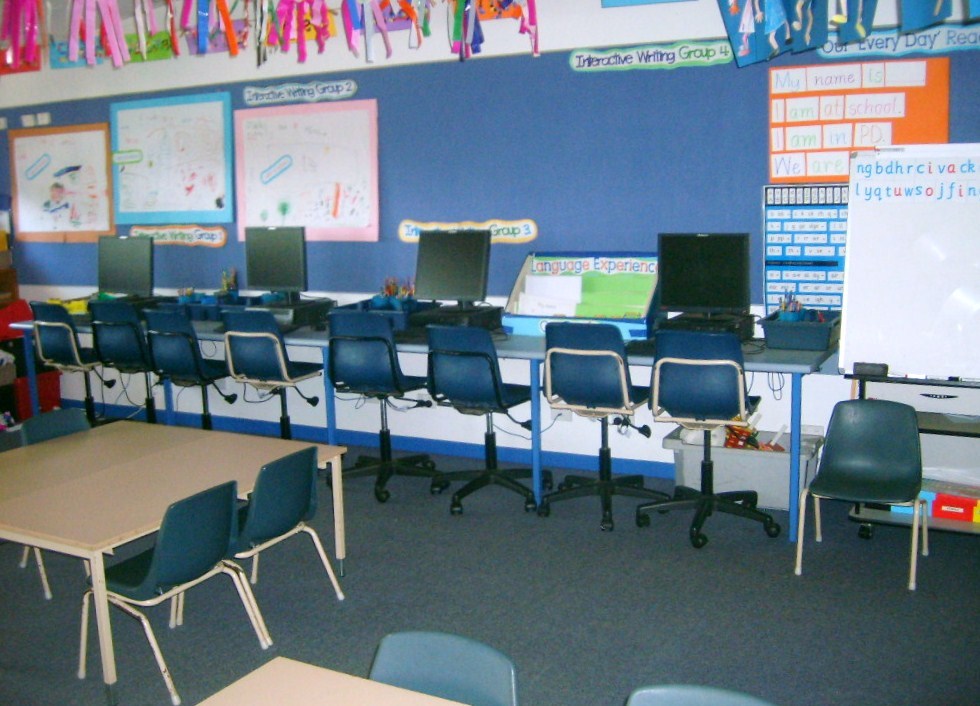
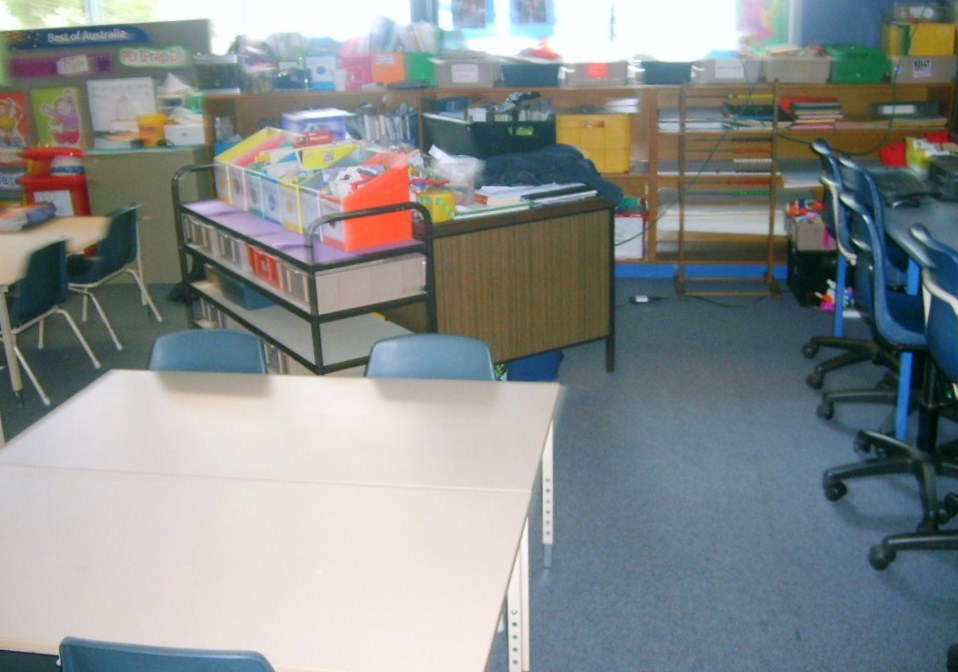
I’ve been asked in a couple of emails if I could display photos of my classroom. Before you take a close look I always state, it’s a classroom, not a lounge room. It can get a little messy! My classroom is a creative space for young learners. I have two teaching spaces which allow the children to move and refocus for different activities or for explicit teaching foci. Children’s work is displayed, books are at a child’s level, and materials are available for children to create. Each teaching area has a white board and I have an IWB at the front of the classroom. The children are able to access the resources they need, with only one cupboard and my desk area being ‘off limits’. The classroom belongs to all members of Team PD. I hand over the shared responsibility for resources and behaviour from day one.
On Thursday, Prep D had two teachers visit to spend part of their day with us. Sue and Nicole from the Mount Dandenong area came to see PD run a PrepD Student Led Interactive Writing session. It’s always great to have visitors and I was very proud of my students. This was their second day back at school for the term! I was also a little anxious about whether they would remember the procedure and use taught strategies. They did!
Our Language Experience sentence was: We write everyday at school.
I’d like to thank Sue and Nicole for the wonderful gift they gave PD. The children and I love the book. The Troll by Julia Donaldson and David Roberts
Having read, and digested the Herald Sun’s (April 17, 2011 p18-19) special report, ‘Old School plan to give literacy a lift’, I’ve felt the need to respond, and I’ve chosen my space to respond to this one…
Teachers may find articulating ‘whole language’ challenging, as it’s not a term ‘bandied’ about in our profession. It’s said, but always requires clarifying even to those ‘within the know’. What you will hear is teachers discuss a ‘balanced’ literacy program. So what does this mean? A ‘balanced’ literacy program recognises the need to provide a ‘varied diet’, a collection of experiences, and explicit teaching for young learners.
Young learners require different approaches within their whole program of instruction to ensure their individual learning needs are met and deep understanding is achieved. This is possibly the best descriptor for ‘whole language’ I can articulate.
Teaching phonics is important within a ‘balanced’ literacy program. The teaching of phonemes, graphemes, consonants, short vowels, rimes and phonograms are essential for children to understand, and use our alphabet, and are… documented learning outcomes in our state curriculum. Victoria has a lot to be proud of!
To teach a program which places greatest or total emphasis on phonics, will not give ‘literacy a lift’ in my opinion, balance will!
We often use the term ‘barking at print’, and this refers to a child which can read aloud fluently, but has very little understanding of what he/she has read. This I see as a huge problem, as parents with aspirations for their children to be wonderful readers, can see fluent ‘reading aloud’ as achievement, the ‘holy grail’, and the harder the book, the bigger the words, the better.
These parents are often presented at a later stage of their child’s schooling with a student achieving lower than expected comprehension levels. And this begs the question, why do we read? You can answer this for yourself, reflect! I’m hoping here, that you’re thinking about the importance of deep comprehension, the pleasure reading can give, developing a love of language, or to learn about and understand our world! Decoding is a skill, comprehension is the goal.
I have responded to this article because I am passionate about literacy acquisition.



















 Nina Davis: Teaching & Learning in Australia